Filter by jurisdictions
- Asia Pacific 18
- Australia 3
- Brazil 1
- California 3
- China 1
- Denmark 1
- Draft proposal 24
- EU 7
- Europe 11
- Final rules 21
- France 1
- India 1
- Indonesia 1
- Japan 2
- Latin America 1
- Minnesota 1
- New Jersey 2
- New Mexico 1
- New York 3
- New Zealand 1
- Oceania 4
- Philippines 3
- Singapore 1
- South Korea 1
- Southeast Asia 8
- Taiwan 2
- UK 3
- US federal 2
- US states 12
- Ukraine 1
- United States 14
- Vietnam 3
- Virginia 1
- Washington D.C. 1
- Washington state 1
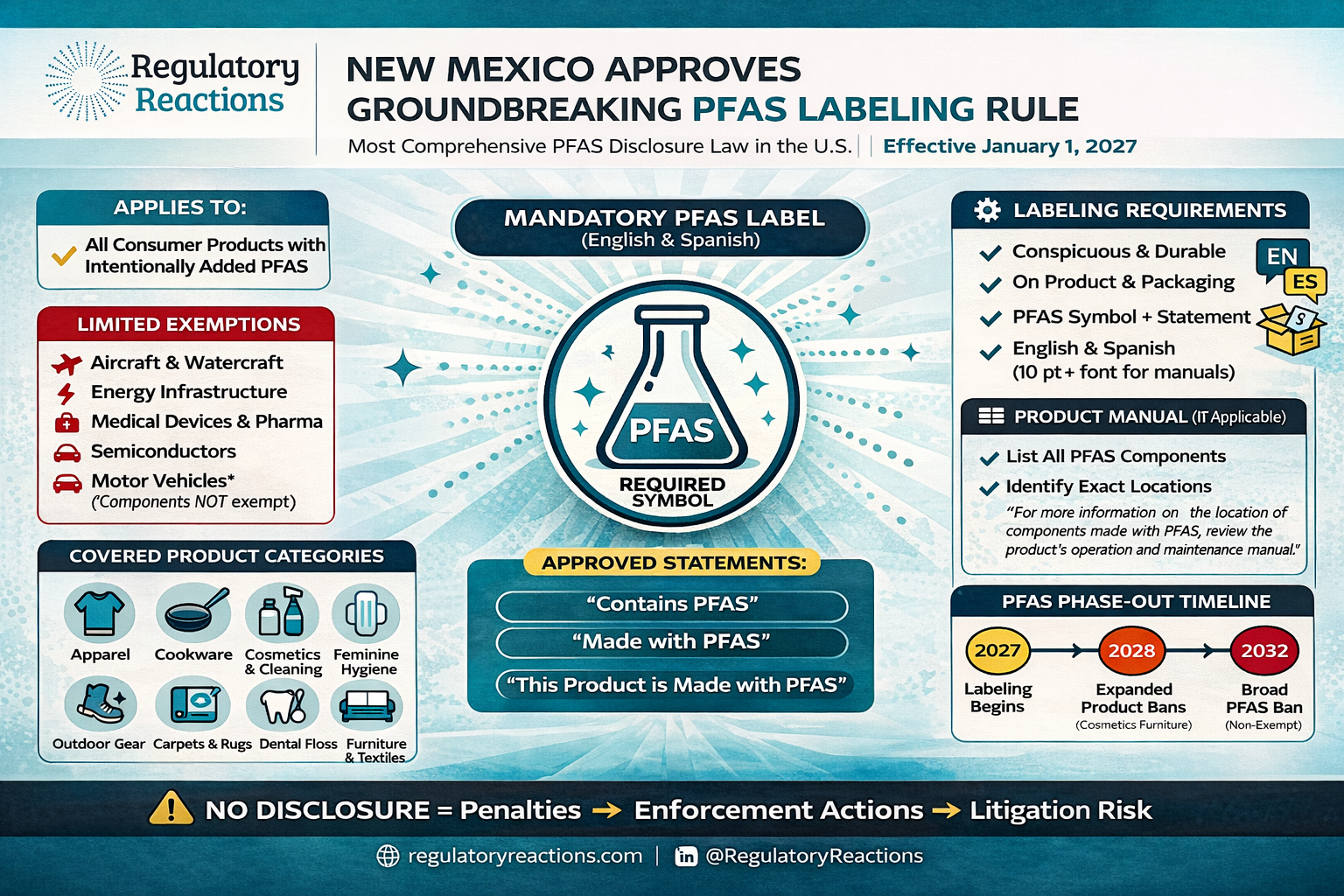
New Mexico approves sweeping PFAS Labeling Rule for Consumer Products
New Mexico mandates PFAS labels on most consumer products by 2027, creating the most comprehensive U.S. disclosure framework.
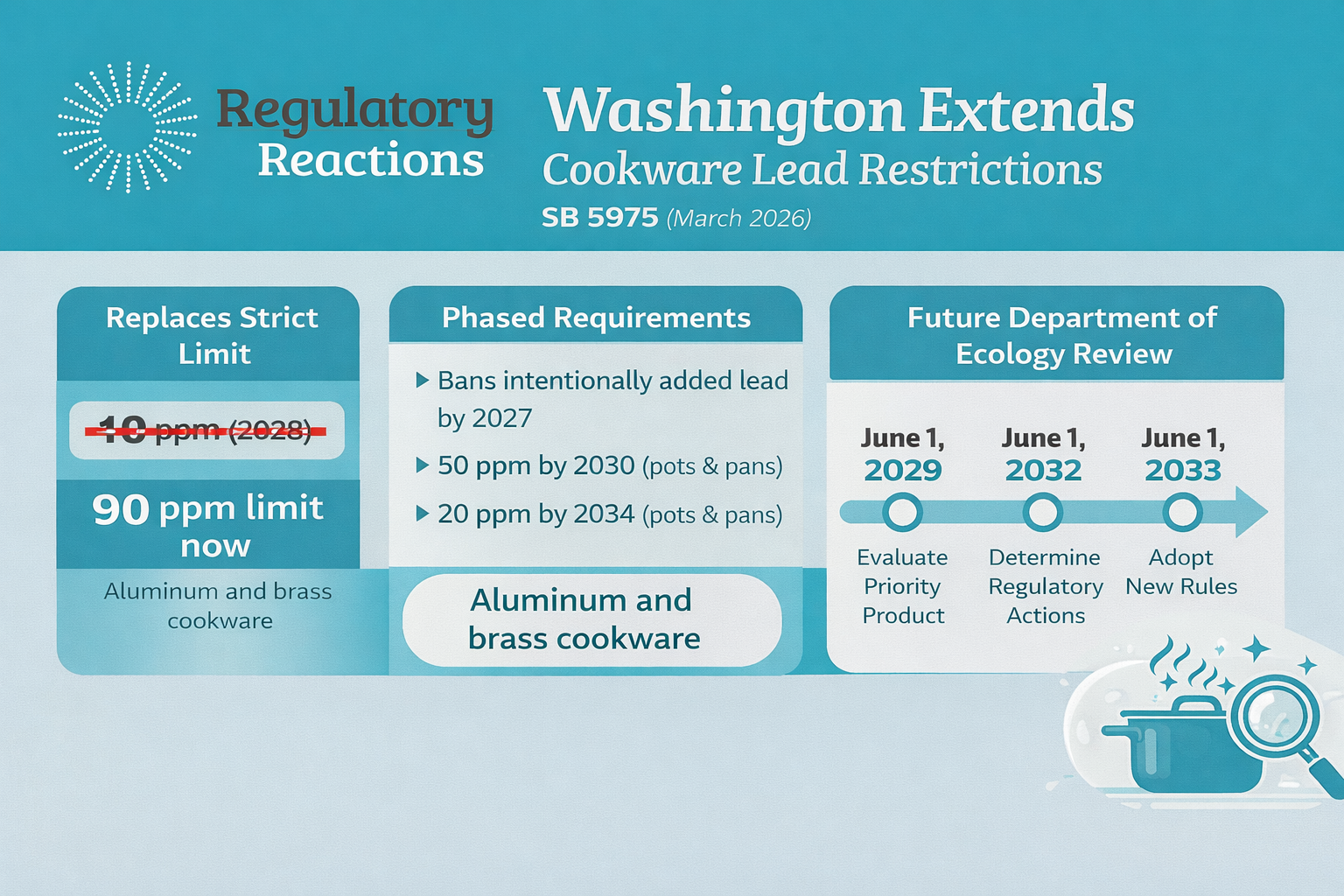
Washington Revises Lead Limits for Cookware, Extends Timeline
Washington enacted SB 5975, replacing a planned 10 ppm cookware lead limit for 2028 with phased limits of 50 ppm (2030) and 20 ppm (2034).
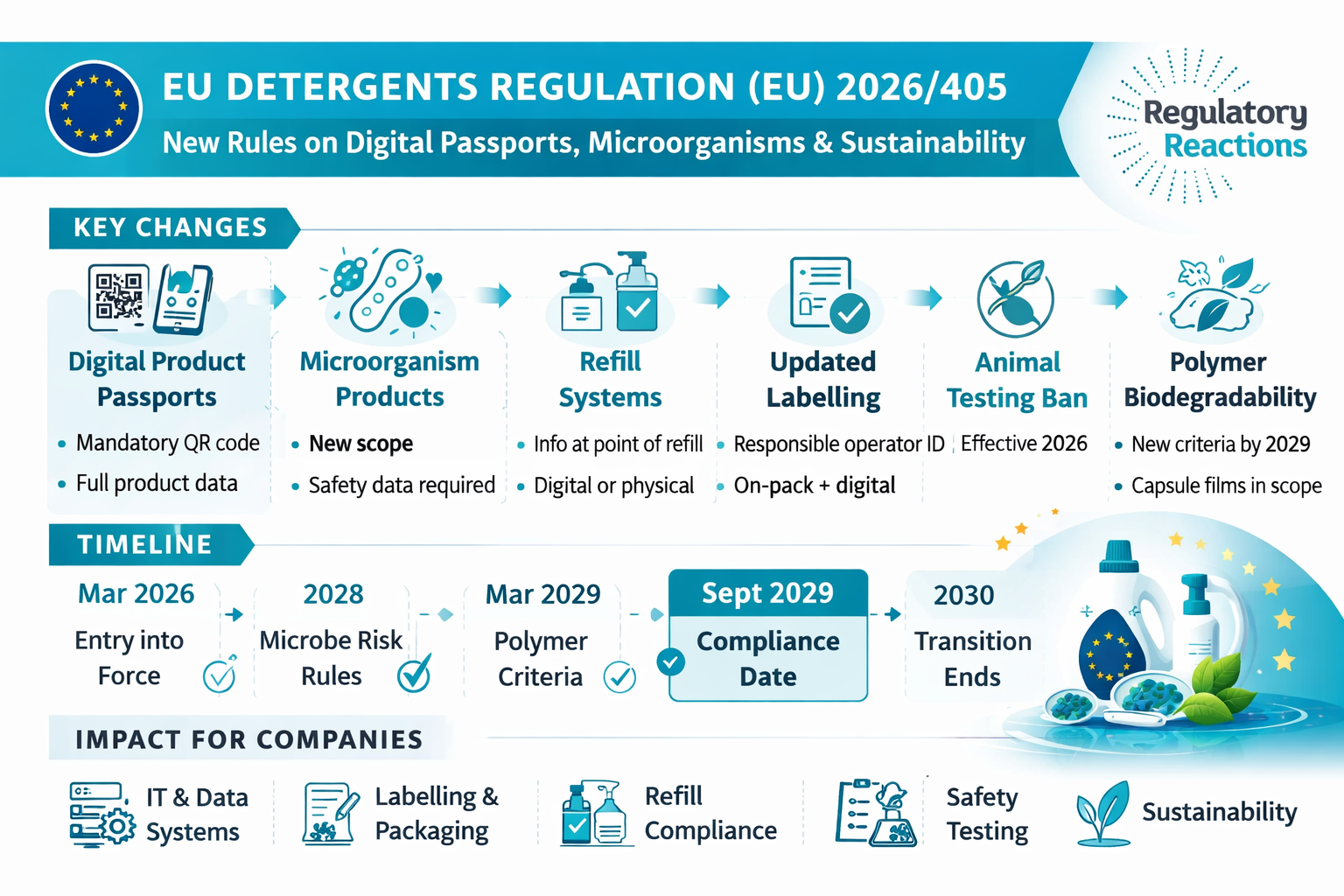
EU overhauls detergent rules, requiring Digital Product Passports, banning animal testing, expanding product types and biodegradability criteria for polymer films
EU adopts Regulation (EU) 2026/405 replacing the 2004 Detergents Regulation, introducing digital product passports and new compliance rules.
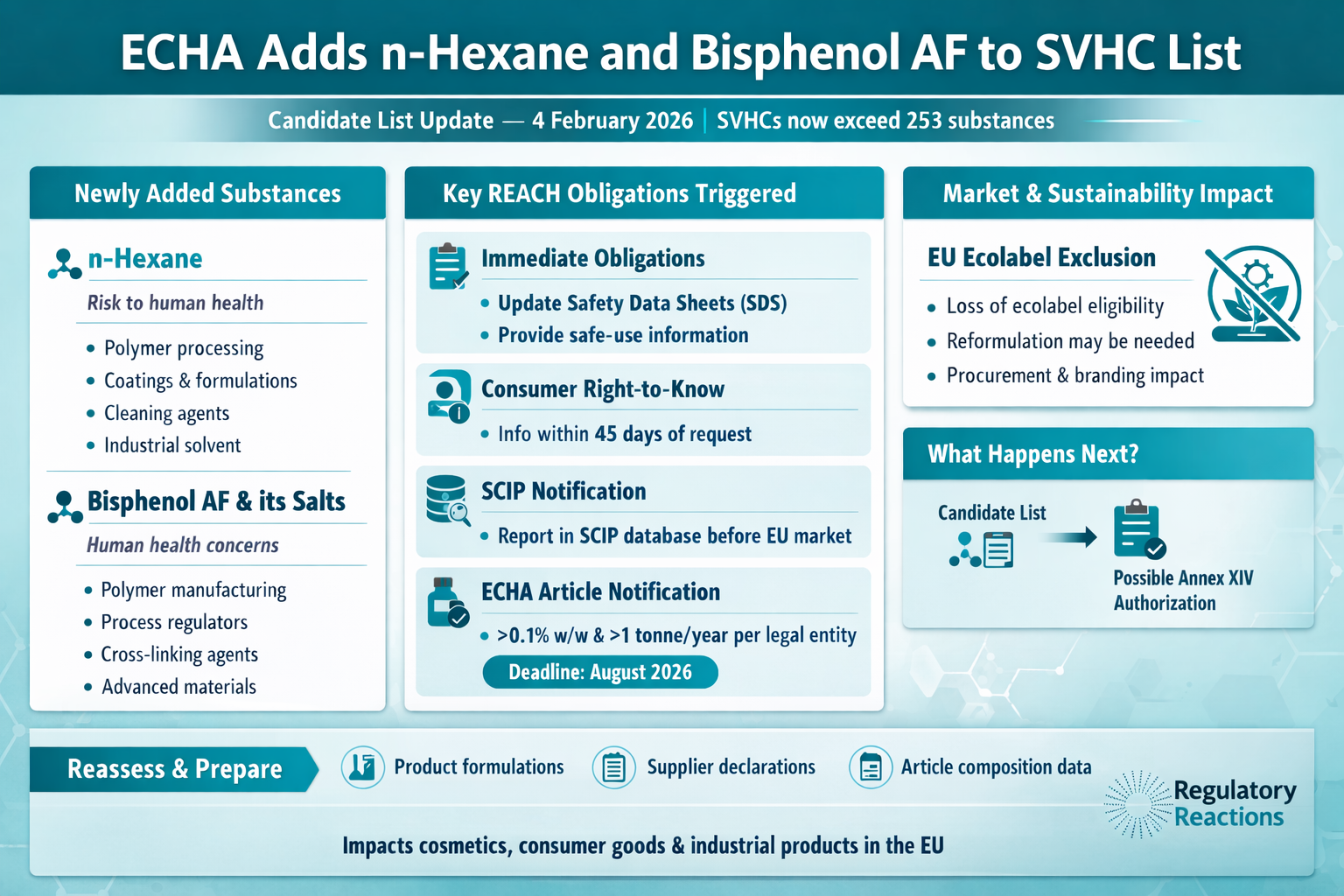
ECHA added n-Hexane and Bisphenol AF to the SVHC list
ECHA adds N-Hexane and Bisphenol AF to the EU SVHC List, triggering immediate compliance duties for downstream users and product brands containing the chemicals
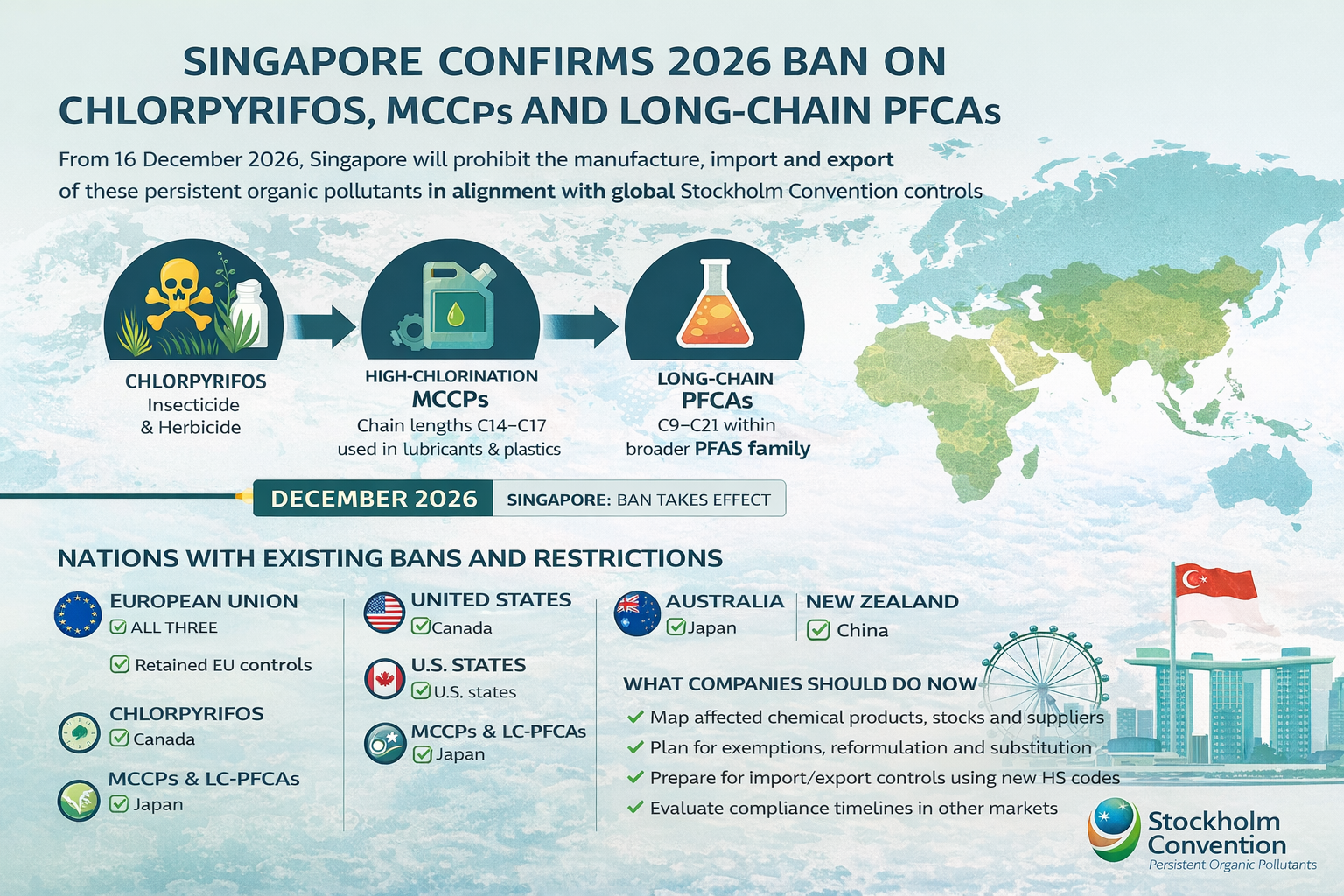
Singapore confirms 2026 ban on Chlorpyrifos, MCCPs and LC -PFCAs under Stockholm Convention
Singapore will ban chlorpyrifos, MCCPs and LC-PFCAs from December 2026, aligning with global Stockholm Convention controls.
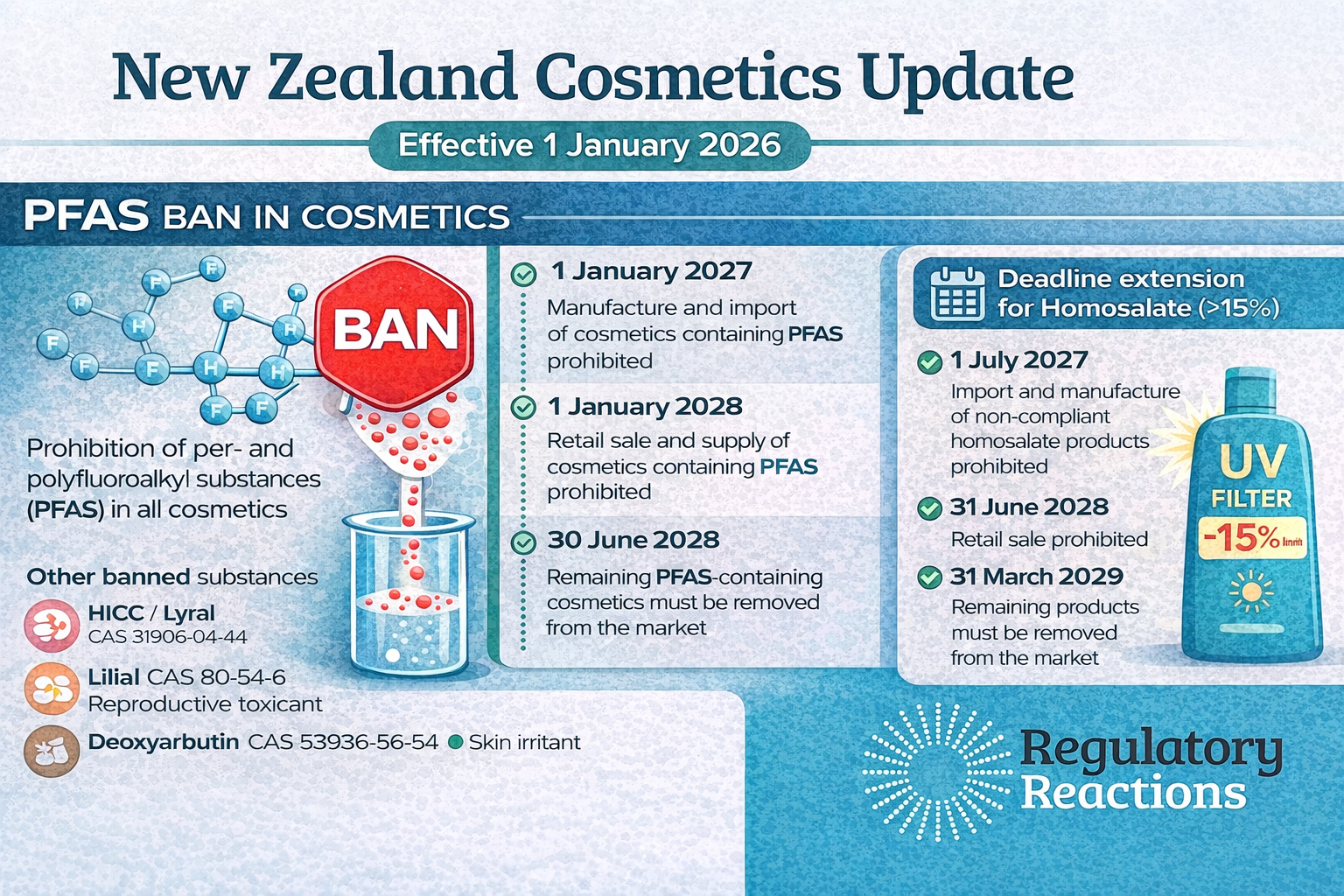
New Zealand phases out PFAS and imposes restrictions on additional chemicals in cosmetic products
New Zealand cosmetics rule revisions took effect 1 January 2026, banning PFAS, lilial, and deoxyarbutin in cosmetics.
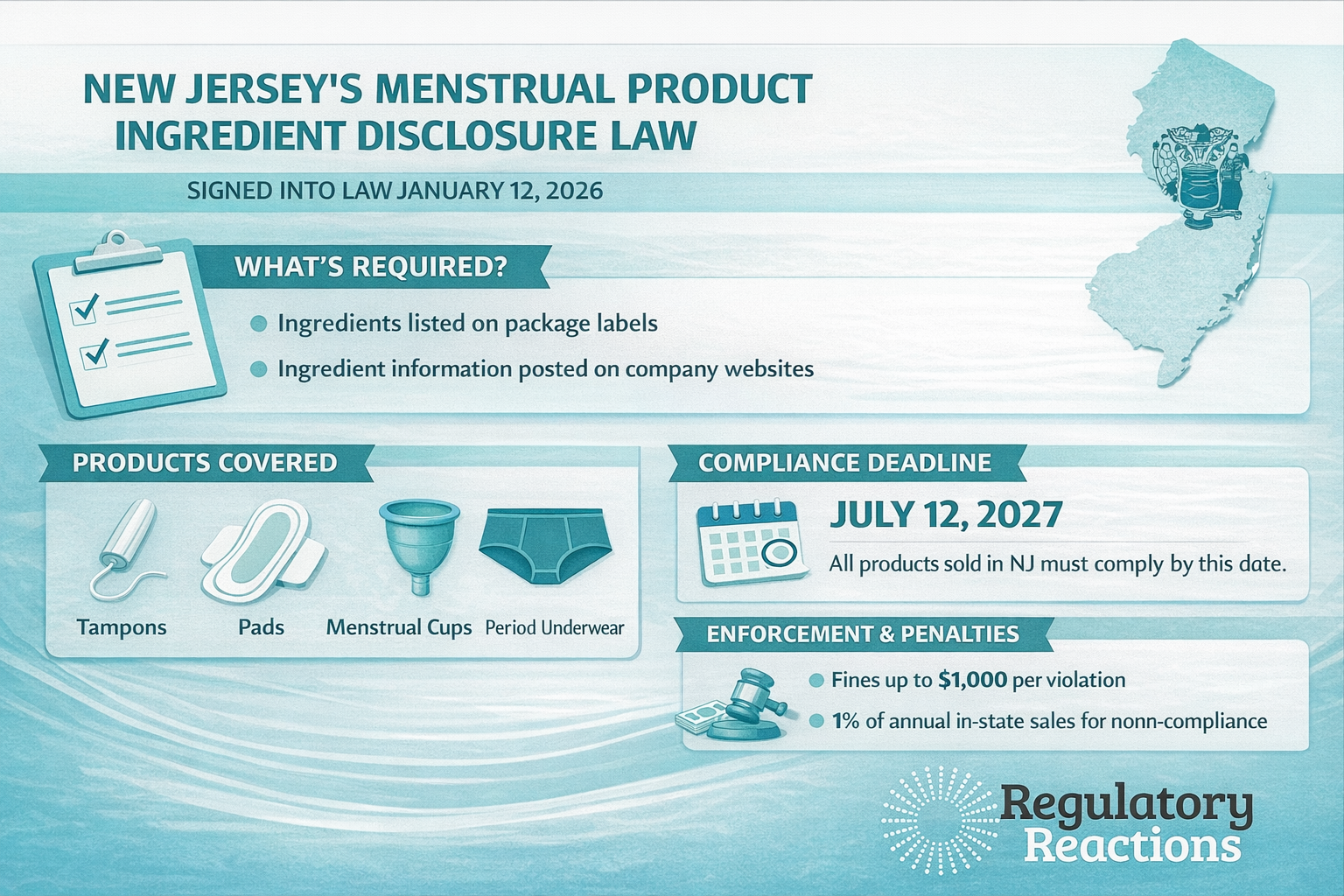
New Jersey requires mandatory ingredient disclosure in menstrual products
New Jersey’s new law requires ingredient disclosure on menstrual product packaging and online. Manufacturers must comply by 12 July 2027.
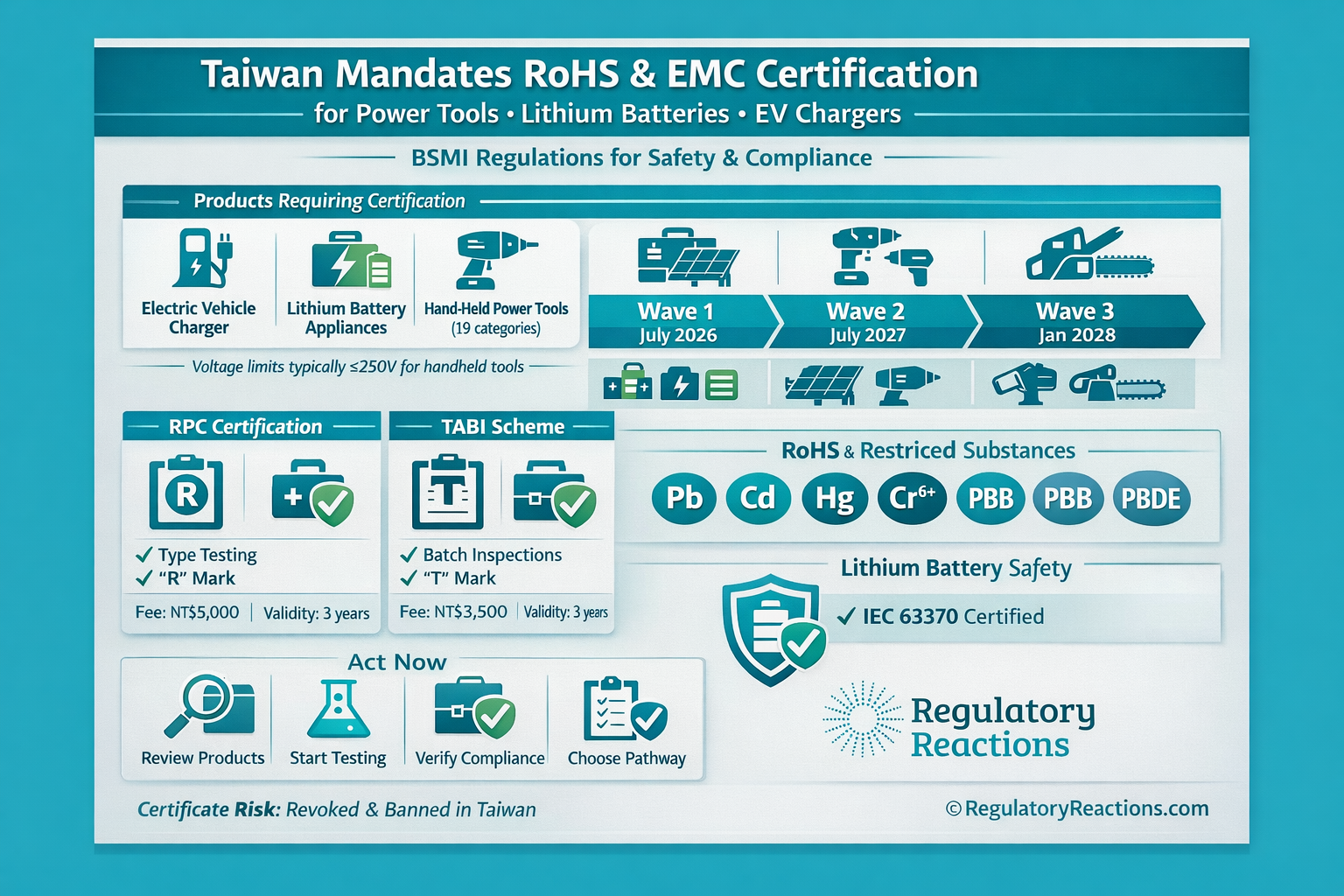
Taiwan requires mandatory ROHS and EMC certification for electric handheld power tools, lithium batteries, and EV chargers
Taiwan requires mandatory EMC and ROHS certification and inspection for handheld power tools. Compliance deadlines commence on
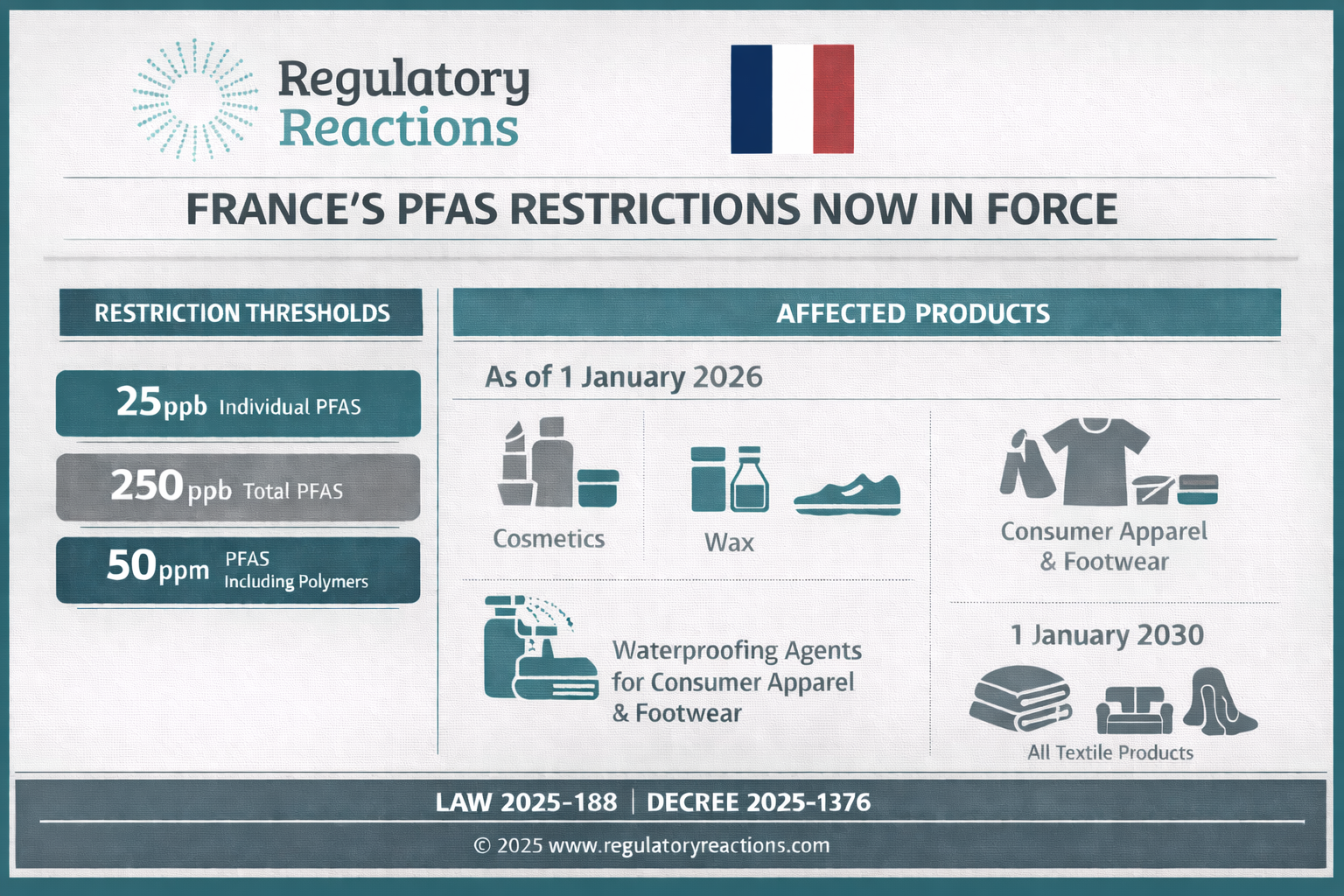
France implements measurable PFAS limits across cosmetics, textiles, wax
France’s PFAS law now in force sets strict product bans and measurable limits for cosmetics, consumer apparel & footwear, wax, and textiles.
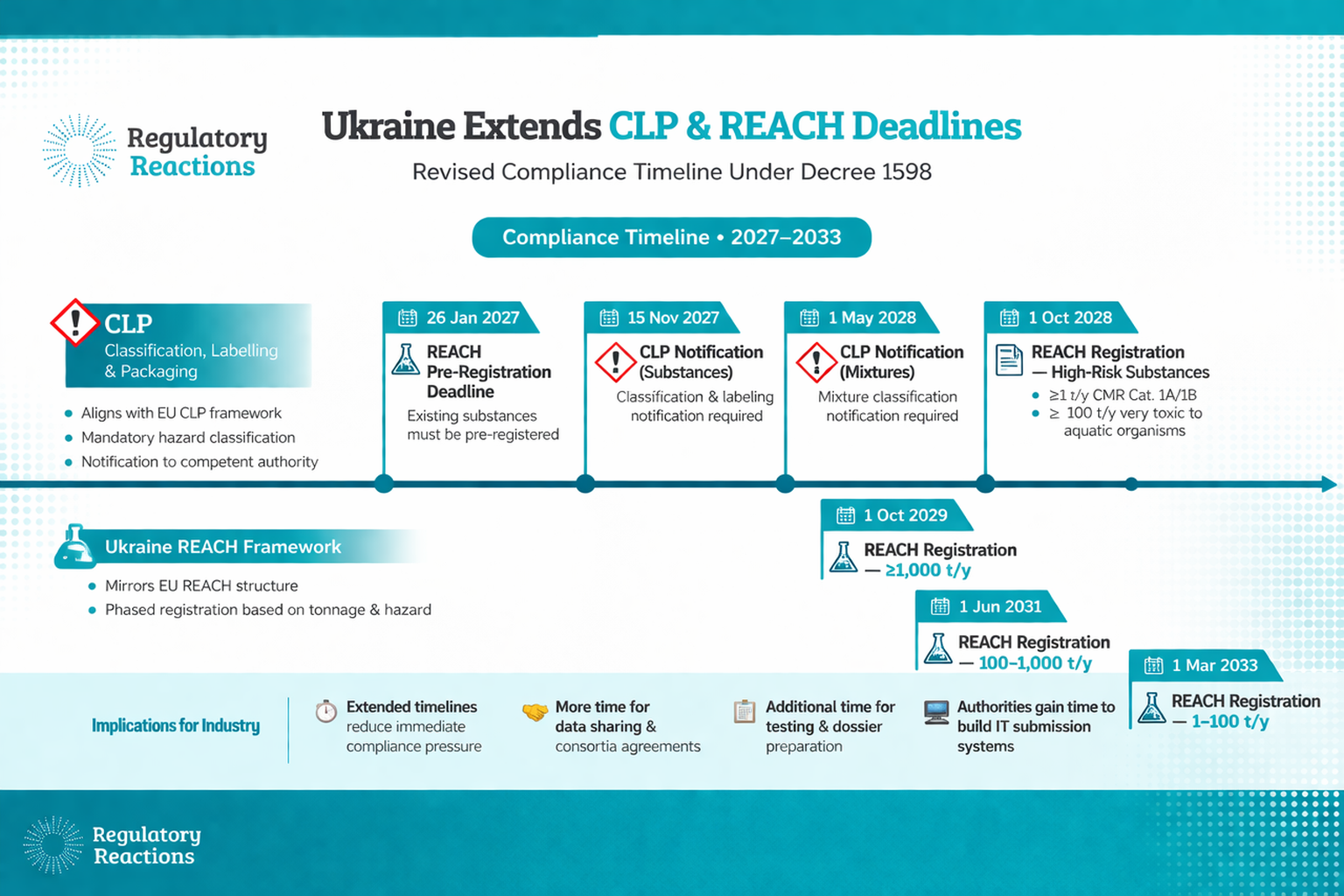
Ukraine extends deadlines for CLP and REACH compliance
Ukraine delays CLP and REACH deadlines to 2027–2033, giving industry more time for CL notification, substance registration, data sharing, and compliance.
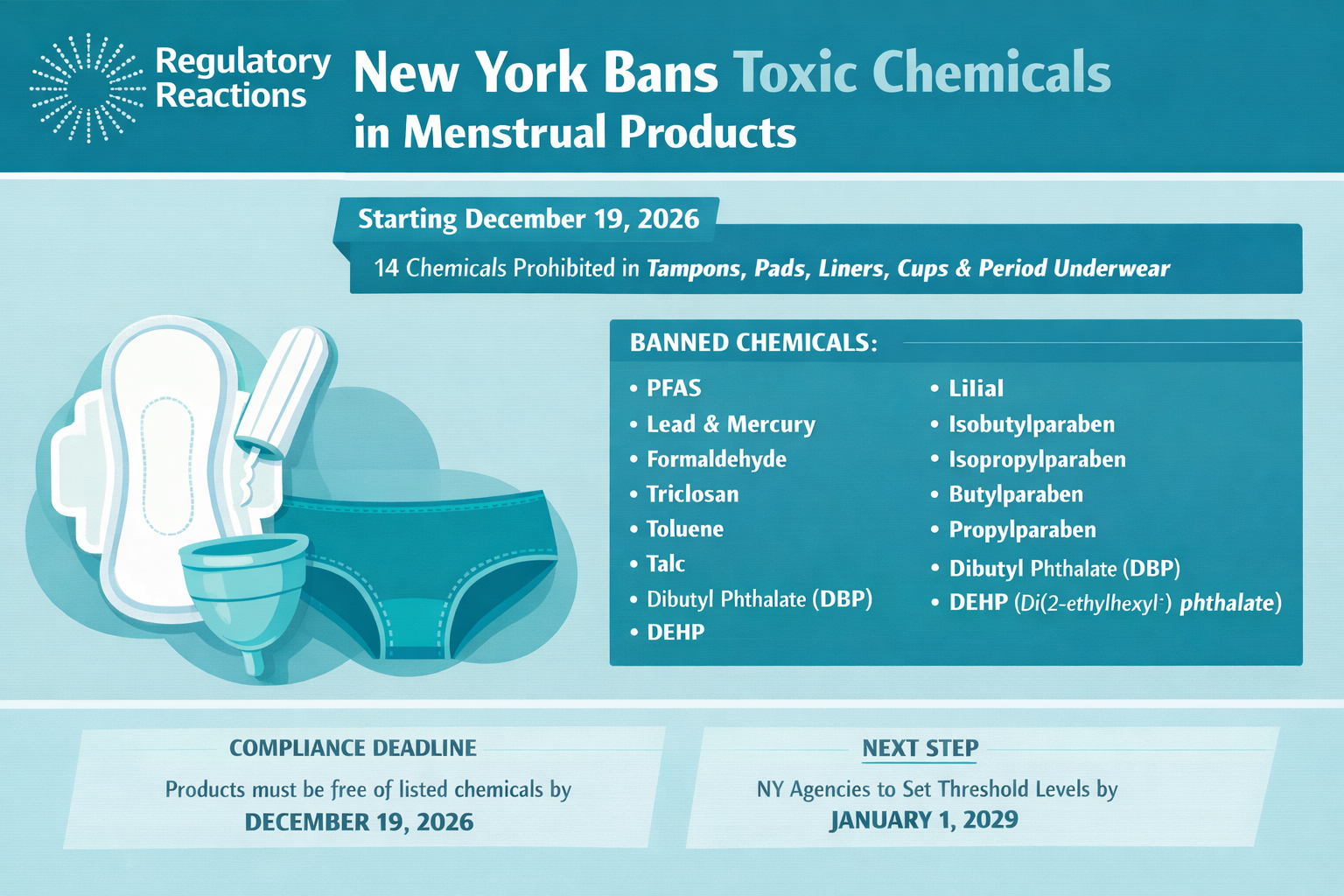
New York bans PFAS, parabens, phthalates, talc and other chemicals in menstrual products
New York bans PFAS, lead, mercury, formaldehyde, phthalates, parabens, and talc in menstrual products by Dec 2026.
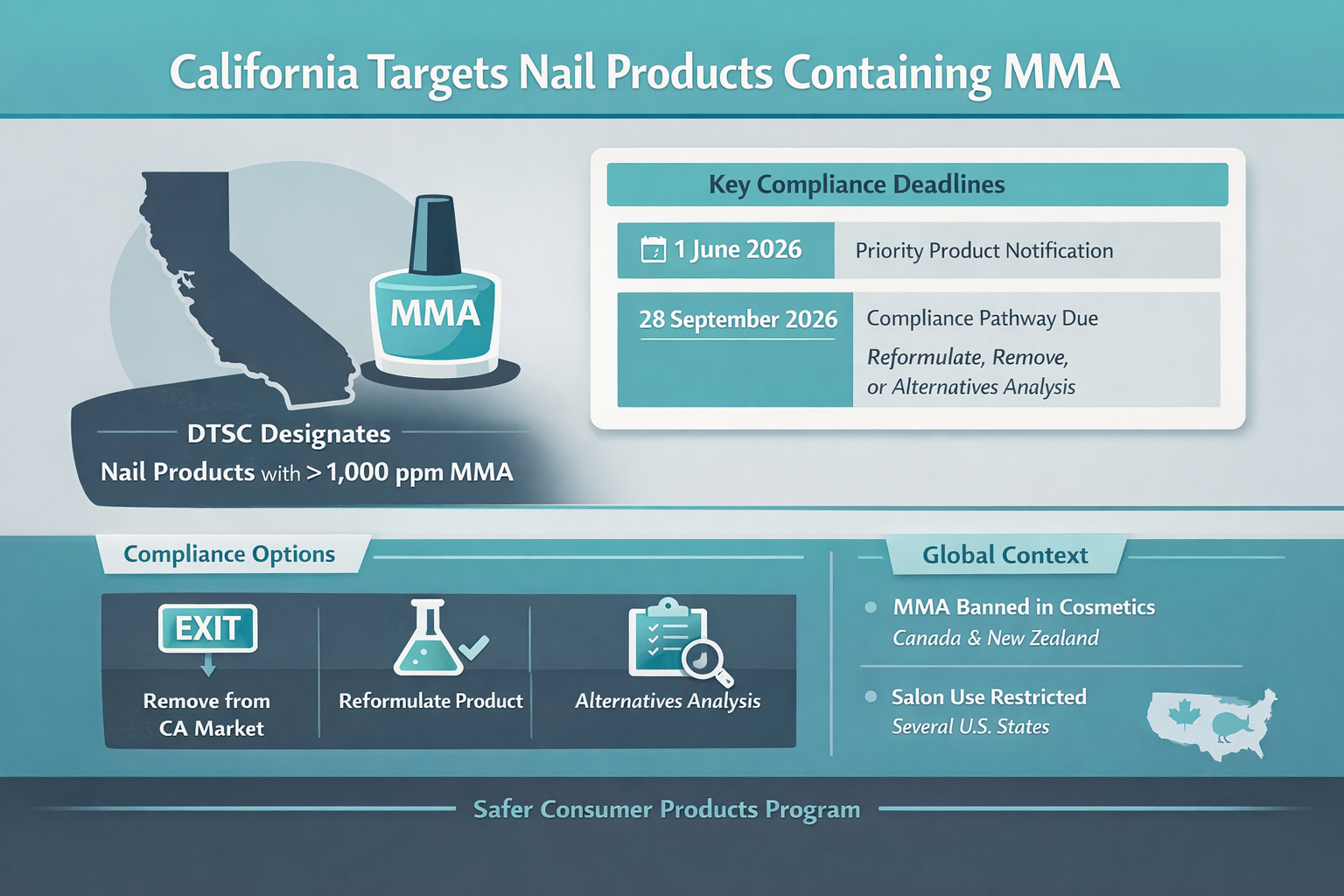
California to phase out MMA in nail products
California finalizes SCP rules for nail products with MMA, setting 2026 deadlines for reformulation or market exit.
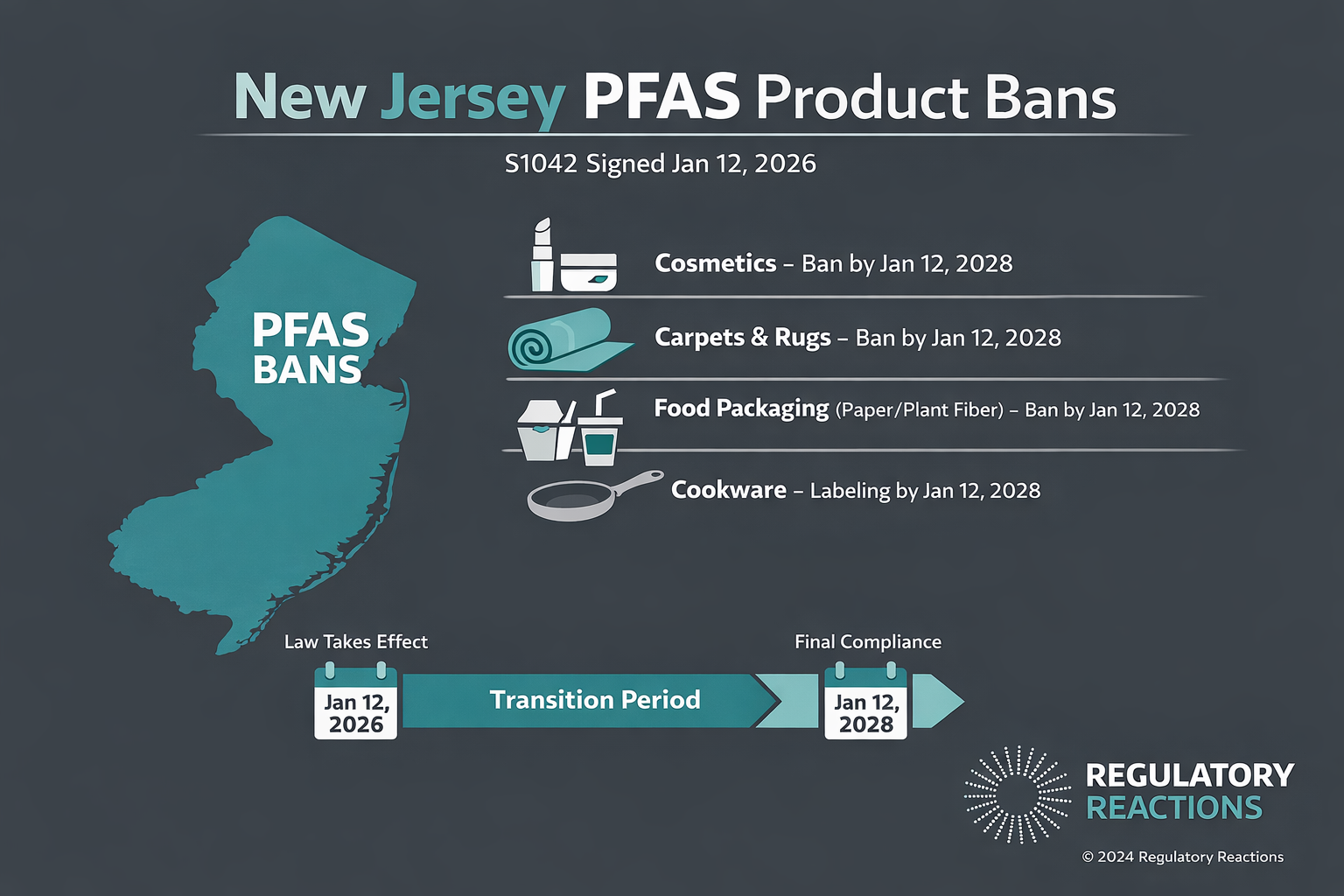
New Jersey moves against PFAS: cosmetics, carpets and food packaging face 2028 Ban
New Jersey Moves Against PFAS: Cosmetics, Carpets and Food Packaging Face 2028 Ban
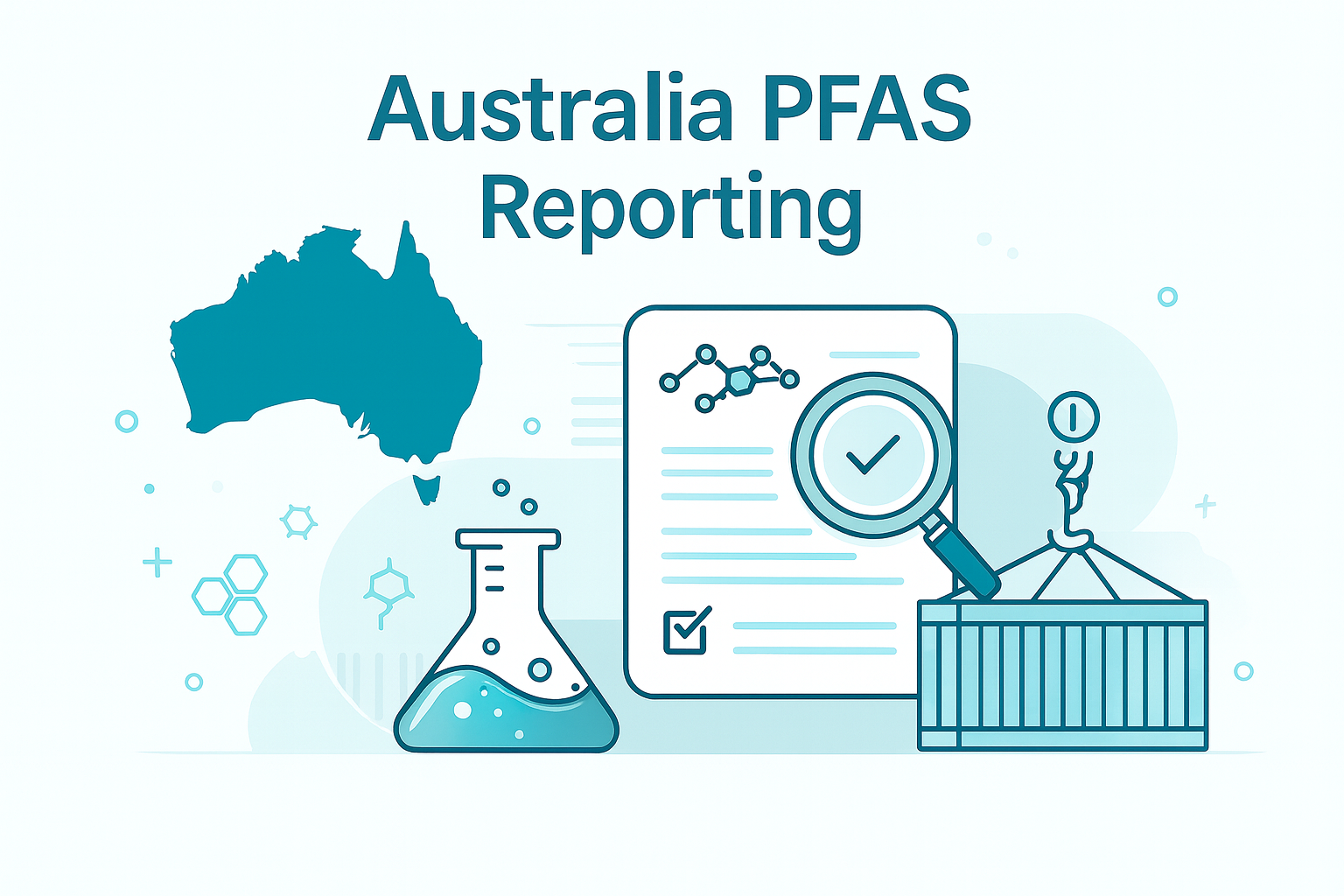
Time is ticking for mandatory PFAS reporting in Australia
Australia launches PFAS review, requiring AICIS registrants to report imports and uses of 522 PFAS substances.
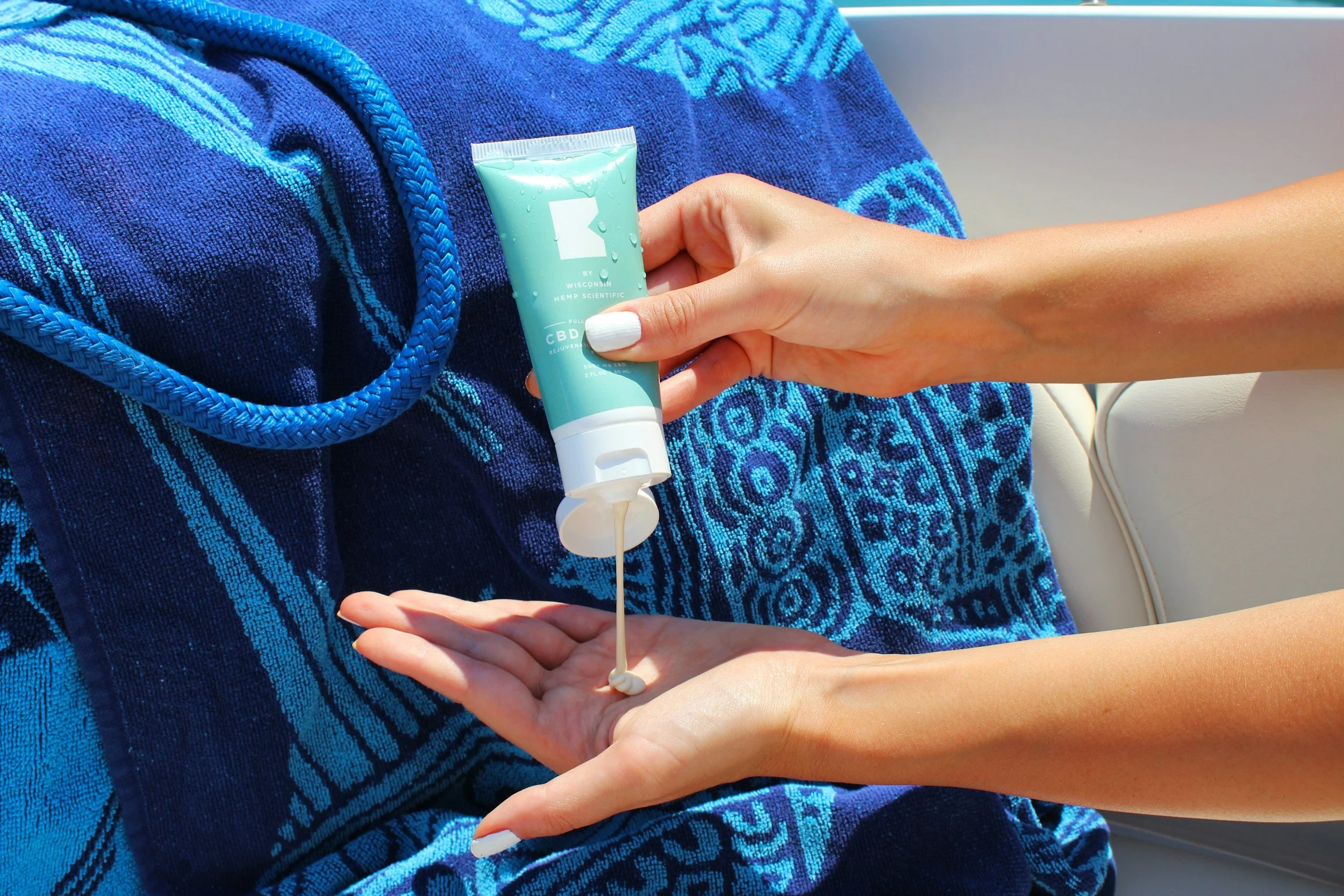
The UK’s restrictions of Oxybenzone in cosmetic products takes effect in early 2026
The UK restricts the use of oxybenzone in cosmetics from 21 January 2026, aligning with EU rules and triggering reformulation across sunscreen and beauty products. The change in the regulation may provide new opportunities for companies.
Australia bans DBDPE, mercury in products and restricts other hazardous chemicals
Australia’s DCCEEW bans the use of decabromodiphenyl ethane (DBDPE, CAS 84852-53-9) starting on 1 January 2027 and mercury compounds starting on 1 July 2026.

Vietnam’s revamped Chemical Law leaves companies with uncertainties
The new Chemical Law law requires mandatory disclosure of hazardous substances in products, notification of new chemicals but provide little details on implementation.
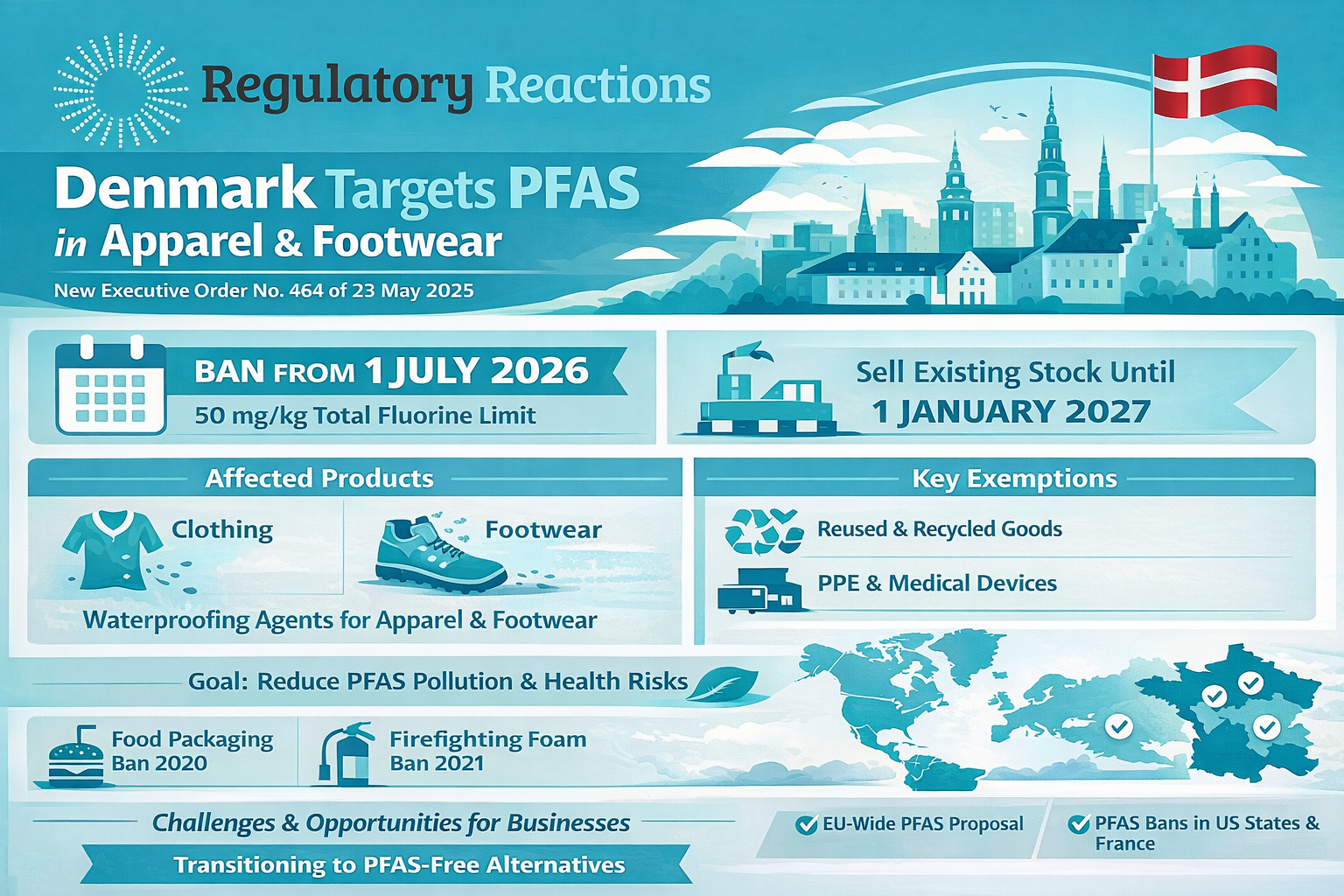
Denmark targets PFAS in apparel, footwear and waterproofing agents under new executive order
Denmark bans PFAS in clothing, footwear and waterproofing agents from July 2026 as global textile PFAS restrictions rapidly expand.
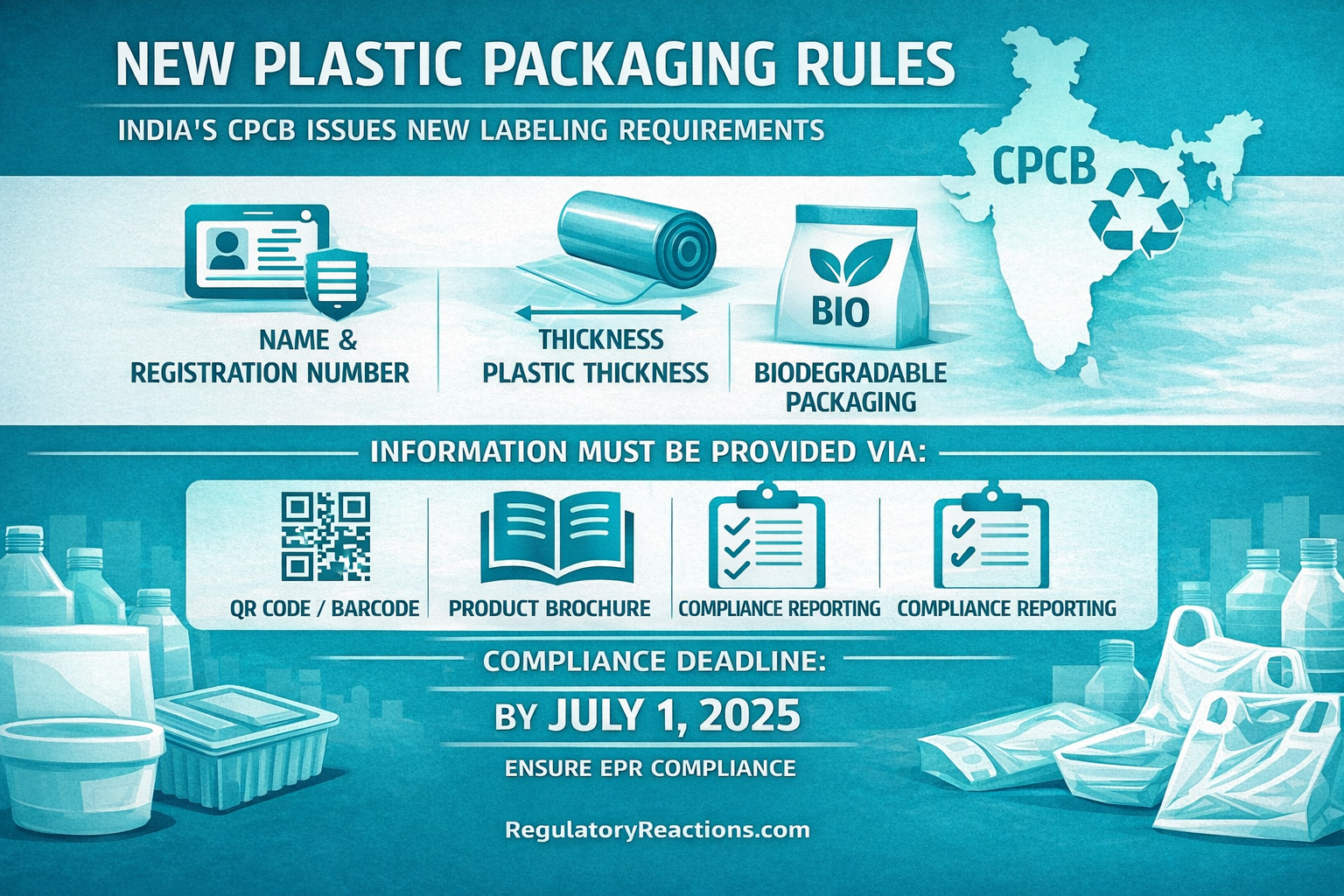
India requires new labelling requirements on plastic packaging to strengthen its plastic packaging EPR scheme
India’s CPCB plans new plastic packaging labels, expanding EPR traceability for producers, importers, and brands by July 2025.
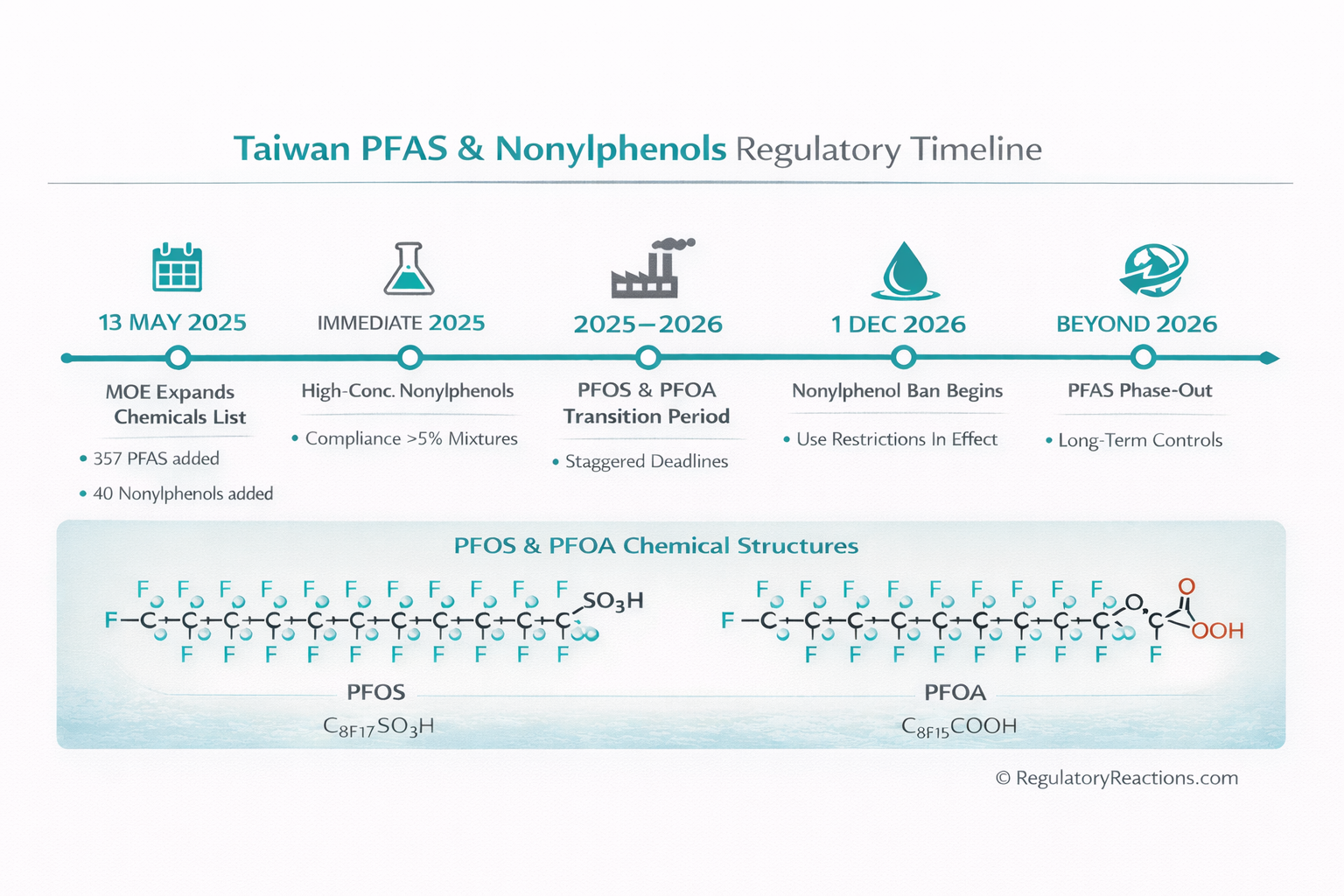
Taiwan’s restrictions on PFOA, PFOS, and nonylphenols substances take effect soon
Taiwan’s restrictions for the 397 PFAS substances, which it consulted with the public in October 2024, and Nonylphenols will take effect starting on 1 June 2025. Industries have a short transition period to comply with the new restrictions.