
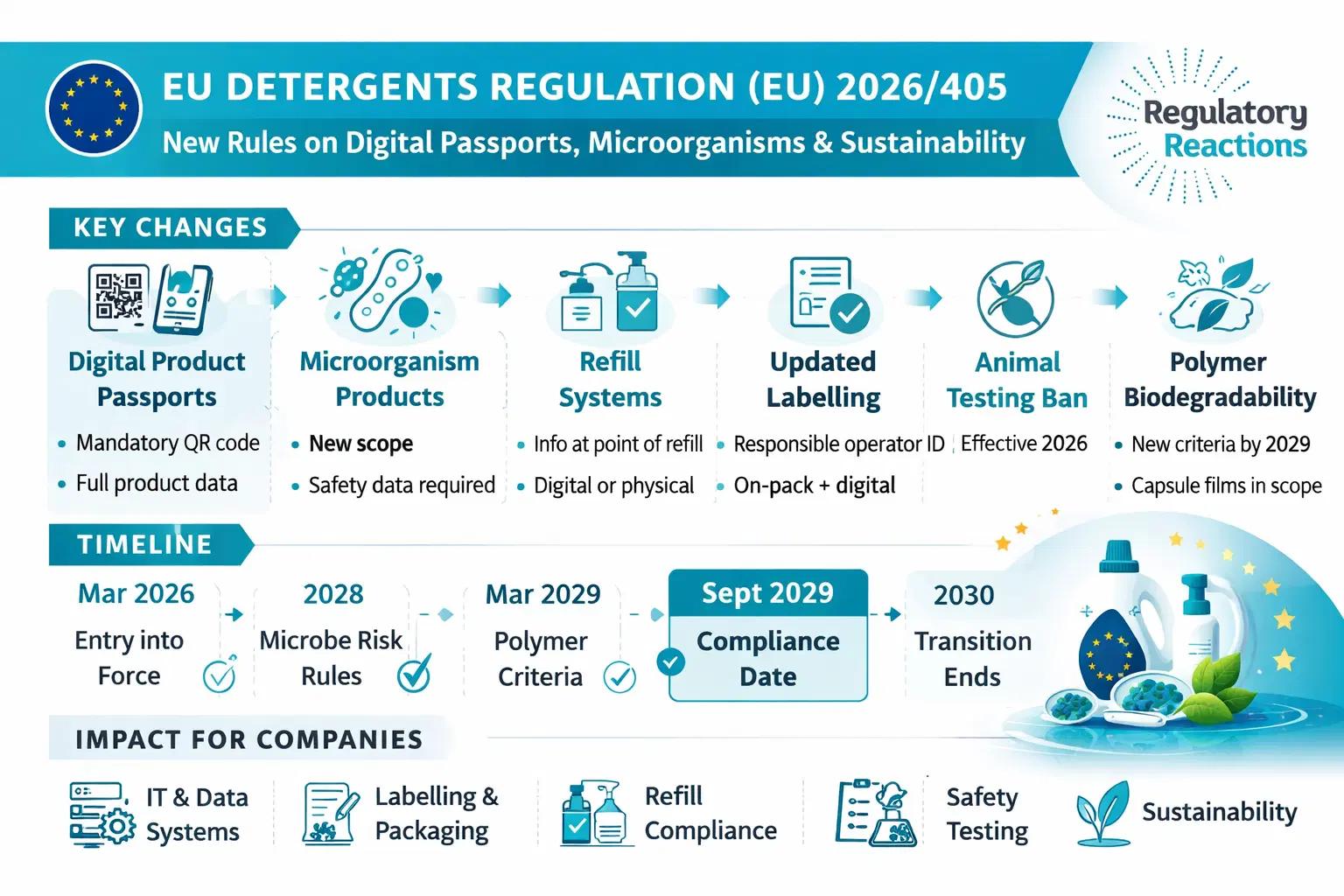
Brussels, Belgium, EU, March 2026 — The European Union has adopted Regulation (EU) 2026/405 on detergents and surfactants, repealing Regulation (EC) No 648/2004, which has governed detergents since 2004.
The new framework introduces Digital Product Passports (DPPs), expands scope to detergents containing microorganisms, updates labeling rules—including digital carriers and refill systems—prohibits animal testing for compliance, and establishes a pathway for new biodegradability requirements for polymers used in detergent products.
The regulation was adopted on 11 February 2026, published in the Official Journal on 2 March 2026, and enters into force on 22 March 2026. Most provisions will apply from 23 September 2029.
Expanded product type for detergents containing microorganisms
Unlike Regulation (EC) 648/2004, which focused primarily on surfactant-based detergents, the new regulation explicitly covers detergents and cleaning products containing microorganisms. Companies must ensure that microorganisms used for cleaning functions:
Do not pose risks to human health or the environment
Are supported by adequate safety and product data
Are assessable through the EU regulatory framework
This change brings biological cleaning products fully within EU detergents compliance requirements. By 23 March 2028, the Commission must establish methodology for microorganism risk assessment for which these products must comply.
Updated labelling requirement
The regulation aligns detergents labeling with the broader EU market surveillance framework by requiring identification of the responsible economic operator, not just a generic responsible party.
Labels must now include:
Name or registered trade name of the manufacturer, importer, or authorized representative
A postal address where the operator can be contacted
For imported products, this means the EU importer must be identified on the label, not only the non-EU manufacturer—a subtle but important compliance shift.
Labelling requirement for refill products
Regulation (EU) 2026/405 introduces specific requirements for detergents sold through refill systems, including:
In-store dispensing stations
Bulk refill points
Automated refill machines
Operators must ensure consumers receive required product information even in the absence of traditional packaging. This includes:
Product identification
Instructions for use
Safety information
Access to the Digital Product Passport
Information may be provided via digital displays, printed materials, or QR codes, creating new operational obligations for refill-based business models.
Digital Product Passport Becomes Mandatory
A central feature of the regulation is the introduction of a Digital Product Passport (DPP) for detergents. Products placed on the EU market must include a digital data carrier (e.g., QR code) linking to structured electronic product information.
Designed to enhance regulatory oversight, poison centre response, and supply chain transparency, the DPP must include:
Product identification (name, category, batch/lot number)
Economic operator details (name, address, contact details for the manufacturer, importer or authorised representative)
Composition data (including surfactants and other ingredients)
Safety information (including poison centre relevance)
Environmental compliance data (e.g., biodegradability)
Compliance documentation (test reports, evidence)
Usage information
Digital versus physical label
Despite the introduction of digital tools, the regulation maintains core physical labeling requirements. Companies must continue to provide on-pack:
Product name
Economic operator contact details
Instructions for safe use
Dosage guidance (for consumer laundry detergents, including water hardness considerations)
Digital carriers may supplement—but not replace—physical labels for:
Extended ingredient disclosures
Technical product details
Additional instructions
Animal testing ban
Regulation (EU) 2026/405 prohibits animal testing to demonstrate compliance with detergents requirements. The prohibition applies to finished detergents and ingredients used in detergents. Companies must instead rely on alternative testing methods and existing scientific data. Data generated before 22 March 2026 may still be used.
The regulation, however, provides member State the authority to grant exemptions where:
No suitable alternative ingredient exists
A substantiated human health or environmental concern is identified
A detailed and justified research protocol is provided
New focus on biodegradability for polymer films used in detergent capsules
Both the old and new regulations require ultimate aerobic biodegradability of surfactants. However, Regulation (EU) 2026/405 addresses a key regulatory gap by targeting water-soluble polymer films, such as those used in single-dose detergent capsules (e.g., PVA films). While no harmonized criteria currently exist, the regulation empowers the European Commission to establish and biodegradability criteria and test methods for polymer films and mandates that these criteria be implemented by 23 March 2029. By 23 March 2031, the Commission is obligated to implement biodegradability criteria and test methods for organic substances intentionally added in a concentration of at least 10% w/w of the total mass of substances, excluding water, in detergents other than surfactants, films, and polymers within films.
Until then, these materials may be subject to:
REACH Regulation (EC) No 1907/2006
EU measures addressing microplastics and polymers
Transitional provisions
Products placed on the market before 23 September 2029 may remain available indefinitely. Products placed between 23 September 2029 and 23 September 2030 may continue to be sold until 23 September 2030 if the product is compliant with the 2004 regulation
Implications for Companies
Regulation (EU) 2026/405 The new regulation introduces significant operational and technical challenges. Companies must implement systems to generate and maintain Digital Product Passports, requiring coordination across regulatory, IT, and product teams.
Companies must also review labeling and packaging practices to ensure the packaging and/or label include required physical information, integrate digital carriers (e.g., QR codes), and support consumer accessibility
Operators of refill systems (e.g. supermarket, grocery or other retail stores) must deploy information delivery mechanisms (digital or physical) at refill points for detergents.
Manufacturers using microorganisms in their products must perform enhanced safety assessments while all companies. must transition to non-animal testing approaches.
Companies using polymer film capsules are likely to encounter future regulatory risk and thus should closely monitor upcoming biodegradability criteria, which may trigger reformulation, new testing or labelling requirements.