
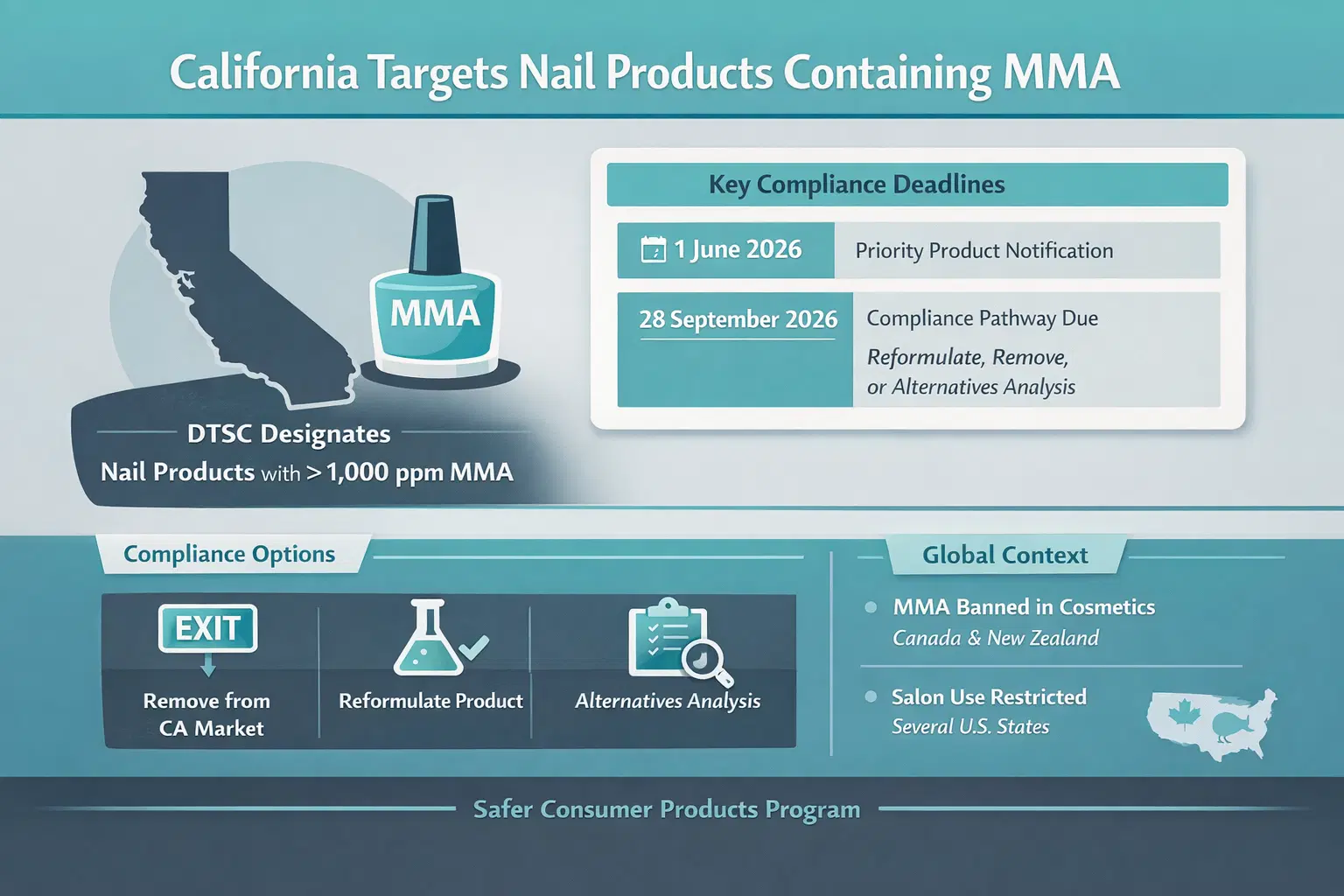
Sacramento, CA, US, December 2025 — The California Department of Toxic Substances Control (DTSC) has finalized the designation of nail products containing methyl methacrylate (MMA) as a Priority Product under California’s Safer Consumer Products (SCP) regulations, triggering new compliance obligations for companies placing affected products on the California market.
The designation applies to nail coatings and artificial nail products containing more than 1,000 parts per million (ppm) of MMA, and covers both domestic and foreign manufacturers whose products are sold or distributed in California. For regulatory purposes, nail coatings include any clear or colored paint, polish, lacquer, enamel, or gel product marketed for use on fingernails or toenails.
Compliance Timeline
DTSC’s final rule establishes two key compliance milestones:
1 June 2026 — Deadline for manufacturers to submit a Priority Product Notification (PPN) to DTSC.
28 September 2026 — Deadline to notify DTSC of one the selected compliance pathways:
Removal of the MMA-containing product from the California market;
Reformulation of the product to eliminate MMA; or
Submission of a Preliminary Alternatives Analysis Report describing plans to substitute MMA.
These deadlines formally initiate DTSC’s alternatives analysis process and require companies to make early decisions regarding product reformulation, market access, and supply chain adjustments.
Global Regulatory Context
MMA is already subject to restrictions in several jurisdictions. Canada and New Zealand have banned MMA in cosmetic products, while California, Ohio, South Dakota, Florida, and Arizona prohibit nail salons and cosmetology schools from using liquid nail products containing methyl methacrylate.
Industry and Supply Chain Impact
The Priority Product designation affects a broad range of stakeholders across the professional nail product supply chain, including formulators, brand owners, contract manufacturers, importers, and distributors supplying salon and retail markets in California. Companies impacted by the rule will need to assess formulation strategies, supplier disclosures, and downstream distribution risks as the SCP compliance process moves forward.