
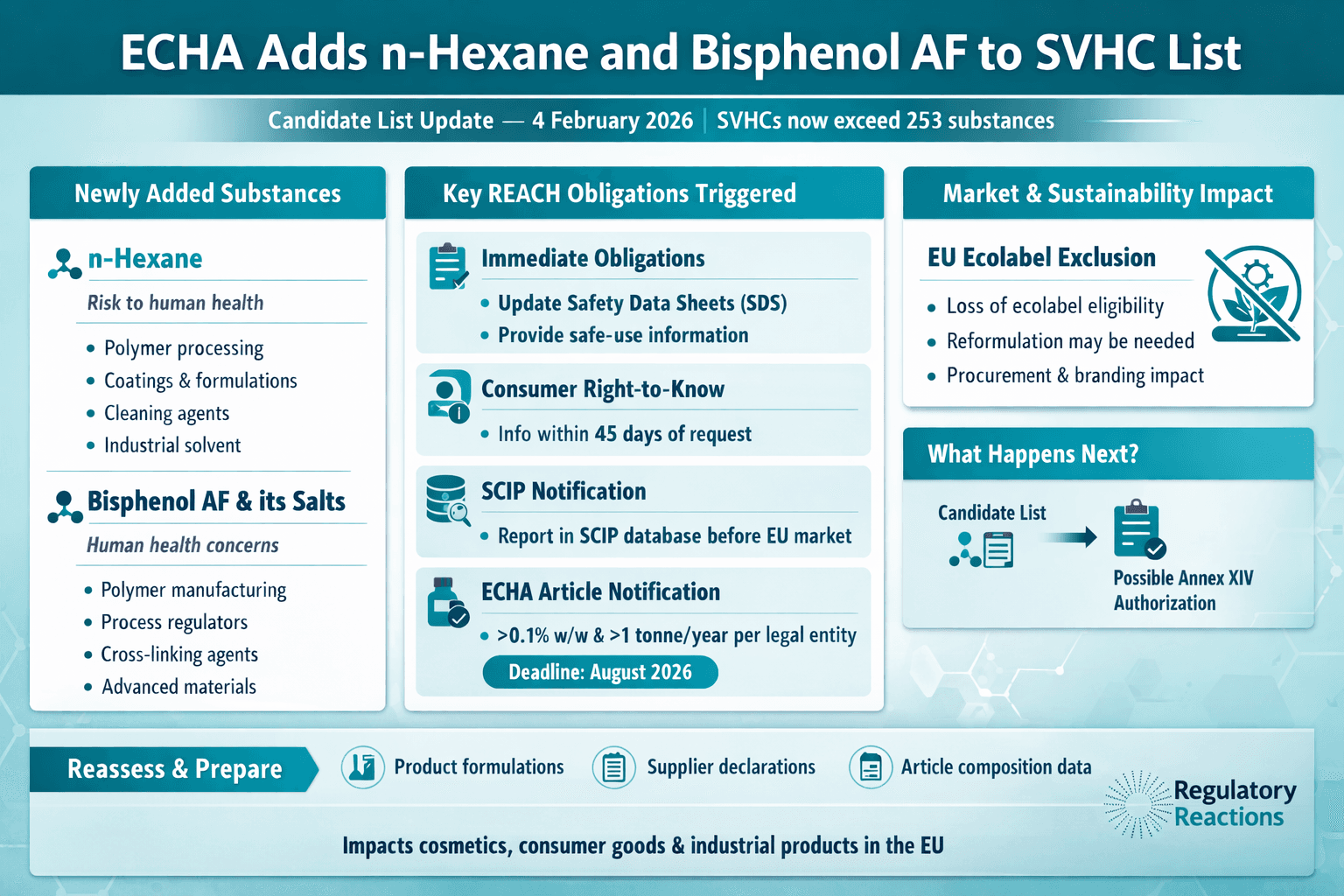
Helsinki, Finland, 4 February 2026 — The European Chemicals Agency (ECHA) has added n-hexane and 4,4'-[2,2,2-trifluoro-1-(trifluoromethyl)ethylidene]diphenol (Bisphenol AF) and its salts , immediately triggering new legal obligations for companies placing products on the EU market. The substances were added due to the risk to human health.
The newly listed substances are widely used in industrial and downstream applications:
n-Hexane is commonly found in formulation, polymer processing, coatings, and cleaning agents, particularly in industrial and professional settings.
Bisphenol EF is used as process regulators and cross-linking agents, notably in polymer and materials manufacturing.
Their broad application profile means the listing will be felt well beyond chemical producers, extending to manufacturers of articles and finished products.
Obligations for products using chemicals on the Candidate List
The Candidate List update took effect upon publication, triggering several obligations under the EU chemicals framework, REACH, without a transition period.
Key compliance deadlines include:
Immediate (from listing date)
Safety Data Sheets must be updated, and safe-use information must be provided to downstream users for substances and mixtures.Within 45 days of a consumer request
Suppliers of articles containing these chemicals above 0.1% w/w must provide consumers with sufficient information to allow safe use.Within six month after placing articles on the market
Notification to ECHA is required if articles contain the substances above 0.1% w/w and exceed one tonne per year per legal entity, unless exposure can be excluded. For substances added on 4 February 2026, the deadline for such is August 2026.Before placing articles on the EU market
Articles containing these chemicals above 0.1% w/w must be reported in the SCIP database under the Waste Framework Directive.EU Ecolabel Exclusion
Products containing these chemicals would lose their eco-label status and companies might be forced to redesign the products or the label. For companies relying on sustainability credentials, this can directly influence market access, procurement opportunities, and branding strategies.
Candidate List inclusion also makes these substances eligible for future authorization requirements. If added to REACH Annex XIV, companies would need regulatory approval to continue use — or substitute with safer alternatives — by a defined sunset date.
With the Candidate List now exceeding 253 SVHCs, ECHA’s decision reinforces the need for companies to reassess product formulations, supplier declarations, and article composition data, particularly for cosmetics, consumer goods, and industrial products sold in the EU.
| Sector | Typical Use of Substances | Primary Regulatory Trigger | Key Obligations | Business Impact Level |
|---|---|---|---|---|
| Chemical Manufacturing & Formulation | n-Hexane in formulations; fluorinated diphenol as process regulator | Candidate List inclusion | Update SDS; communicate SVHC status to downstream users; prepare for potential Authorisation | High |
| Polymers & Plastics Processing | Cross-linking agents; solvents in processing | SVHC in mixtures or articles | SDS updates; Article 33 communication if in articles; SCIP notification if >0.1% w/w | High |
| Paints, Coatings & Surface Treatments | Solvent use (n-hexane); specialty additives | SVHC in mixtures/articles | SDS updates; customer notification; possible reformulation pressure | High |
| Industrial & Professional Cleaning Products | Solvent-based cleaning agents | SVHC in mixtures | SDS updates; customer safe-use communication | Medium–High |
| Electrical & Electronic Equipment (EEE) | SVHCs in polymer components, housings, cables | SVHC in articles | Article 33 disclosure; SCIP notification; supply-chain data collection | High |
| Automotive & Transport Equipment | Plastics, coatings, sealants | SVHC in articles | SCIP notification; consumer right-to-know responses; possible design changes | High |
| Consumer Goods (General) | Plastics, coatings, adhesives | SVHC in articles | Article 33 disclosure; SCIP notification; consumer inquiries | Medium–High |
| Textiles & Technical Fabrics | Polymer treatments; coatings | SVHC in articles | Article 33 disclosure; SCIP notification; EU Ecolabel ineligibility | Medium |
| Construction Materials | Coatings, sealants, polymer components | SVHC in articles | SCIP notification; customer communication | Medium |
| Importers & Distributors (EU/EEA) | Import of substances, mixtures, or articles | Candidate List entry | Ensure SDS accuracy; submit ECHA notifications; respond to consumer requests | High |
| Sustainable / Ecolabel-Focused Products | Any SVHC-containing product | EU Ecolabel Regulation | Automatic loss of EU Ecolabel eligibility | High (Commercial) |