
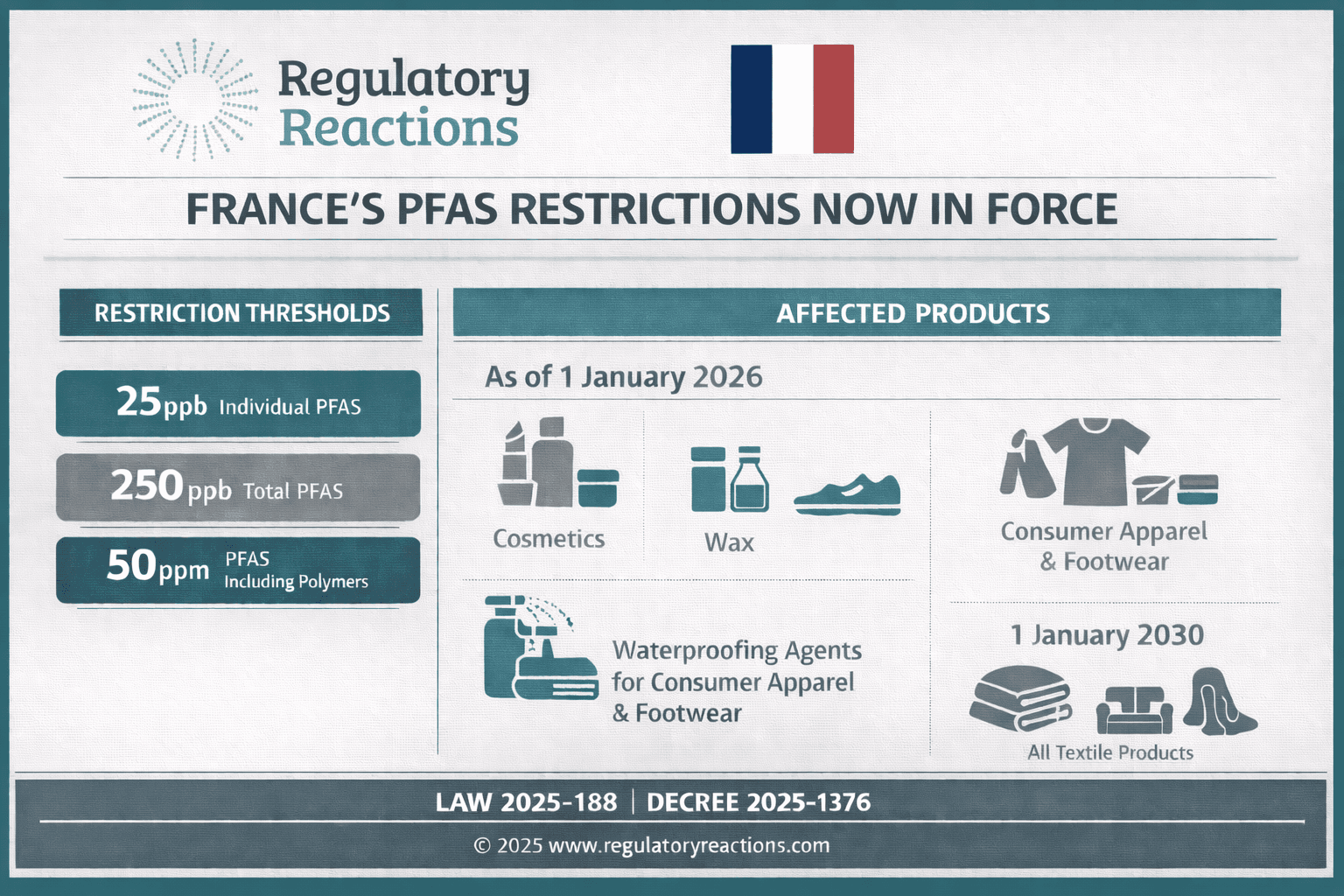
Paris, France, December 2025 — France’s 2025 PFAS legislation has now moved into its implementation phase. With the publication of Implementing Decree No. 2025-1376, enforceable product restrictions entered into force on 1 January 2026, giving practical effect to Law No. 2025-188 of 27 February 2025.
The law introduced a national prohibition on per- and polyfluoroalkyl substances (PFAS) in certain consumer products, cosmetics, textiles, footwear, waterproofing agents, and ski wax products. The decree now provides the technical detail necessary for enforcement, including concentration thresholds and defined exemptions.
Product Scope Effective 1 January 2026
Under Law 2025-188, France prohibits the manufacture, import, export, and placing on the market of PFAS-containing:
Cosmetic products
Ski wax products
Consumer apparel textiles
Footwear
Waterproofing agents for consumer apparel and footwear
Textile Expansion in 2030
Beginning 1 January 2030, the restriction will extend to all textile products, subject to specific exemptions.
The law provides exemptions for:
Industrial technical textiles, such as filtration media, conveyor belts, high-performance industrial membranes, and specialized reinforcement fabrics not intended for consumer use
Products used for national defense, including armed forces equipment and civil protection systems
Personal protective equipment (PPE) covered by Regulation (EU) 2016/425, and where no viable PFAS alternative exists, including firefighter protective clothing, chemical-resistant garments, and certain industrial safety apparel
Medical sanitary textiles where PFAS use is considered essential and no substitute is available
Products containing 20% or greater post-consumer recycled content, subject to proportional limits
While there are specific exemptions, the extension to all textile products could also include toys, furniture, or household or commercial furnishings such as textile napkins, beddings, drapery, rugs, or automotive parts which are made from textiles (e.g. fabric seatings, etc.).
Defined Concentration Thresholds
A key feature of Implementing Decree No. 2025-1376 is the introduction of measurable compliance limits. A product is considered non-compliant if it exceeds:
25 ppb for any individual PFAS (excluding polymers)
250 ppb for the sum of PFAS (excluding polymers)
50 ppm for PFAS including polymeric forms
These thresholds provide enforcement authorities with objective laboratory-based criteria for determining compliance.
Alignment with Broader European Measures
France’s limits are consistent with the EU’s PFAS restrictions in food contact materials under the Packaging and Packaging Waste Regulation (PPWR), which will apply from 12 August 2026.
At the EU level, Denmark, Germany, the Netherlands, Norway, and Sweden have jointly proposed a broad PFAS restriction under REACH. That proposal remains under evaluation, with consultation expected to begin after March 2026.
International Context
Outside the European Union, several U.S. states have adopted similar product-based PFAS prohibitions covering cosmetics, food packaging, ski wax, and textiles.
With defined thresholds now in force, France’s framework is among the most structured national PFAS regimes in the EU. Companies placing products on the French market must align testing, documentation, and supply-chain controls accordingly.