



Trenton, New Jersey, US, January 2026 — New Jersey has moved to expand consumer transparency in menstrual health products with the passage of Senate Bill S3643, legislation requiring manufacturers to disclose the ingredients used in menstrual products sold in the state.
Governor Phil Murphy signed the legislation on January 12, 2026, after lawmakers approved New Jersey Senate Bill S3643, later substituted by New Jersey Assembly Bill A2437. The measure was enacted as P.L.2025, c.232.
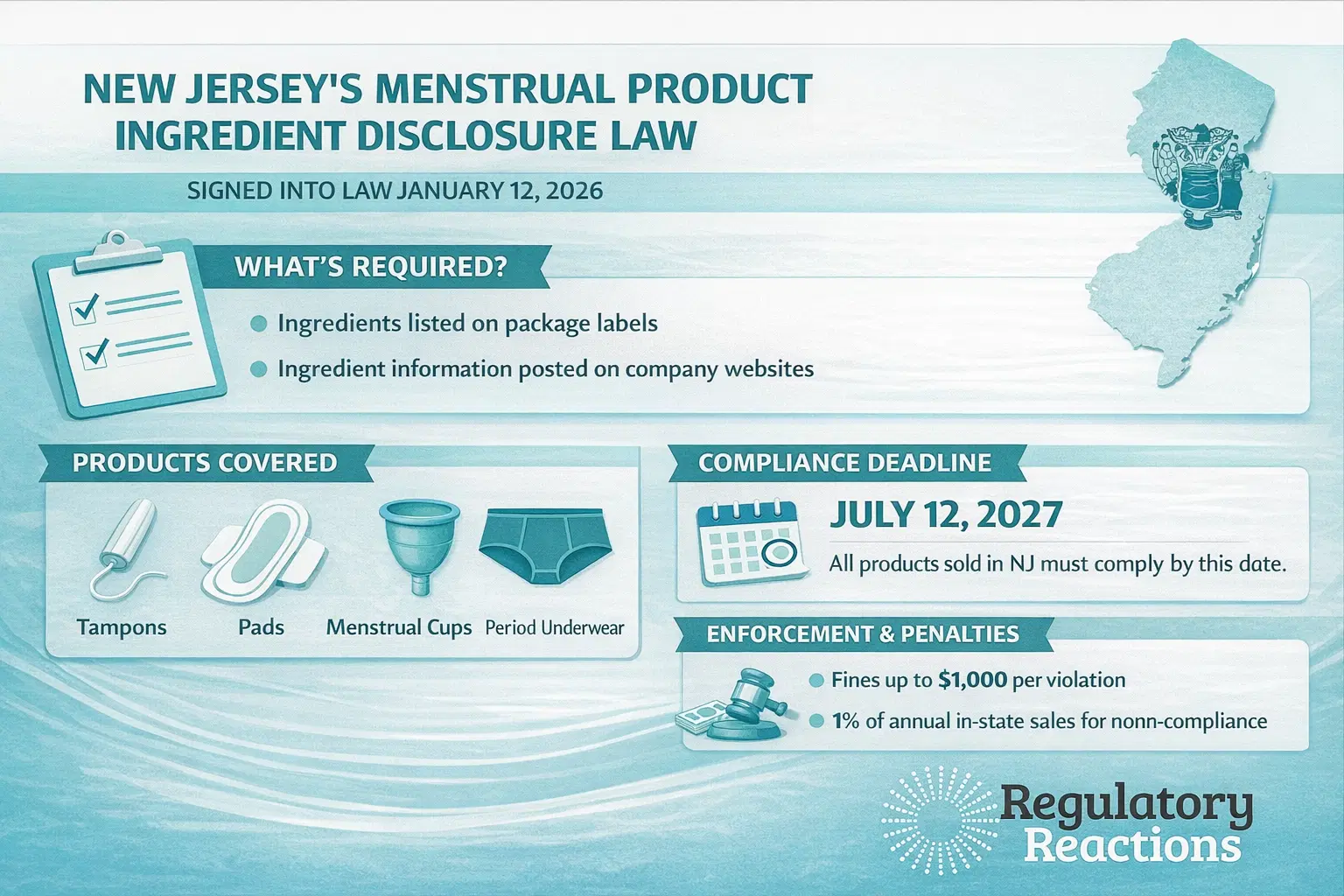
The law requires ingredient disclosure on product packaging and online for menstrual products sold in New Jersey.
Ingredient Disclosure Now Required
Under the new law, every package or box containing menstrual products sold in New Jersey must display a label listing all intentionally added ingredients contained in the product in descending order of predominance within the product.
The affected products cover both disposable and reusable products and include:
Tampons
Sanitary pads
Menstrual cups
Menstrual discs
Menstrual underwear
Online Disclosure
Manufacturers must also publish the ingredient list on their website in an electronically readable format. Packaging may direct consumers to the disclosure through digital tools such as QR codes or web links. If product formulations change, companies must update ingredient disclosures within 18 months.
Trade Secret Protection
The law allows manufacturers to protect confidential business information. If an ingredient qualifies as a trade secret under federal or state law, companies may identify it using a common name rather than disclosing its full proprietary identity.
Compliance Timeline & Enforcement
Manufacturers have 18 months after the law’s effective date, or 12 July 2027, to update packaging and online disclosures. Products manufactured before the end of the transition period are exempt from penalties. Failure to comply may subject companies to a civil penalty equal to 1% of their total annual in-state sales of menstrual products, capped at $1,000 per non-compliant package. The New Jersey Division of Consumer Affairs will enforce the law.
Legislative intent
Recent studies have revealed that many menstrual products contain harmful chemicals linked to serious health effects, such as gynecological conditions, some cancers, high blood pressure, liver and thyroid disease, fertility issues, and developmental problems in children.
“Menstrual products are integral to daily life, yet recent studies reveal that many contain harmful chemicals linked to serious health risks, including high blood pressure, fertility issues, and certain cancers. Despite these dangers, many manufacturers are not required to disclose these ingredients on their product packaging,” said Senate Majority Leader Ruiz (D-Essex/Hudson) and co-sponsor of the law. “By requiring detailed ingredient labels, we can empower women to choose safer options and push companies to eliminate harmful chemicals and find healthier alternatives.”
“More and more, we are learning of the harmful effects of exposure to forever chemicals and other toxic ingredients in the products we use every day. This includes menstrual products, which come into contact with some of the most sensitive areas of the body,” said Senator Turner (D-Mercer/Hunterdon). “People who menstruate have a right to know exactly what ingredients are in the products they use. Requiring clear, transparent labels on menstrual products will empower consumers to make informed choices and better protect their health and well-being.”
Growing Trend in Ingredient Transparency for Menstrual Products
By enacting this law, New Jersey joins a growing number of states requiring transparency for menstrual products. California’s law, which mirrored New Jersey’s, came into effect in 2023. A similar bill is pending in Virginia. Nevada and New York have also required disclosure of ingredients on the product label but no online disclosure.