
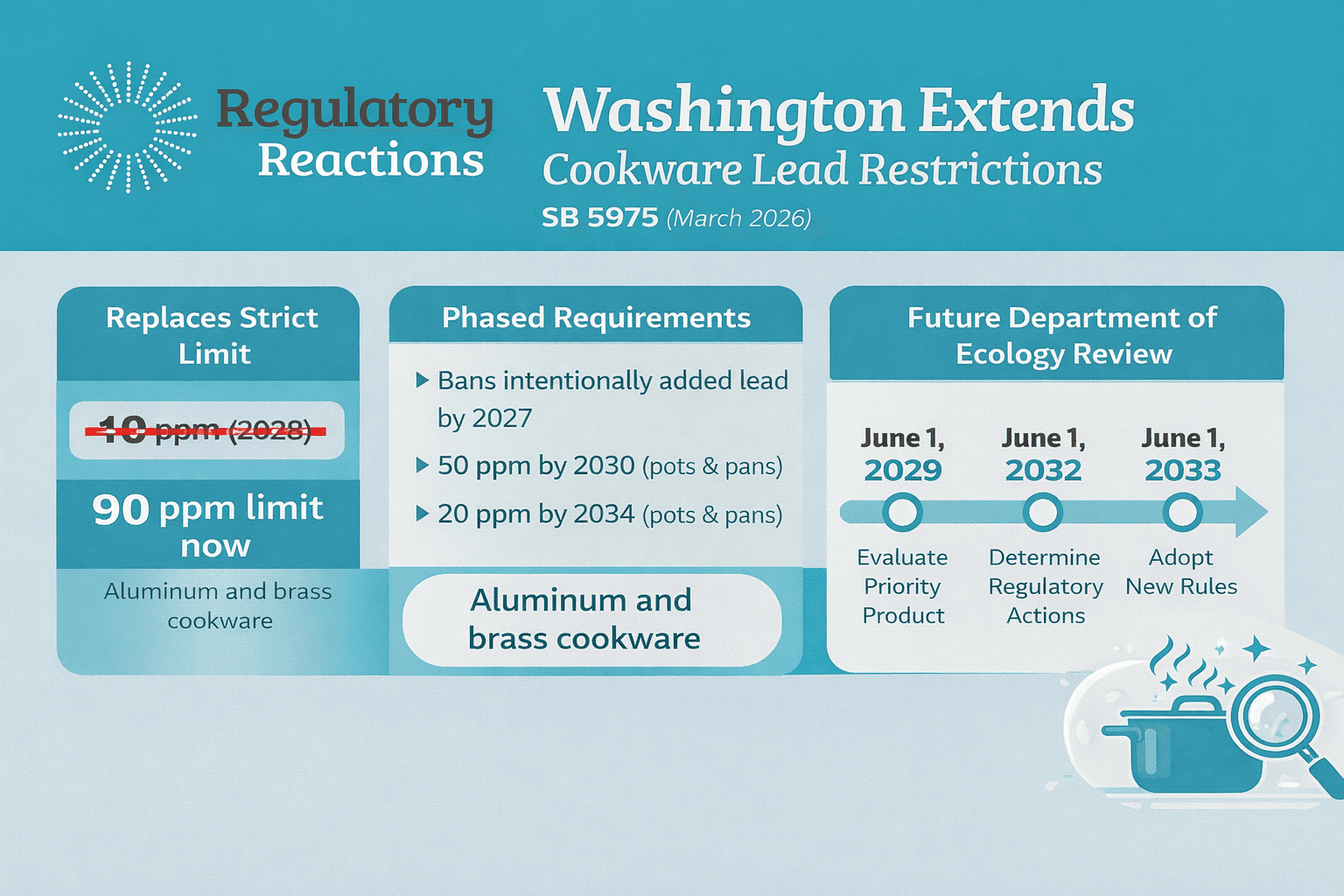
Olympia, Washington, March 2026 — Washington State has enacted Senate Bill 5975 (2025–2026 session), revising its lead restrictions and compliance timelines for cookware and extending compliance timelines The law targets aluminum and brass cookware and replaces previously stricter limits with a phased approach, marking a shift from earlier regulatory direction.
Clear definition
The law clarifies the scope of regulated aluminum and brass cookware to include pots, pans, kettles, griddles, grills, and internal cooking vessels in appliances such as rice cookers and pressure cookers. It also establishes exemptions for cookware fully enclosed in stainless steel, electrical components of cooking devices, and the bodies of electronic appliances with removable cooking containers.
Lessen restrictions and extended timeline
Under prior requirements, aluminum and brass cookware were subject to a 90 ppm lead limit beginning January 1, 2026. SB 5975 retains this baseline but introduces phased restrictions. Beginning January 1, 2027, cookware may not contain intentionally added lead. By January 1, 2030, lead concentration in pots and pans must not exceed 50 ppm, followed by a further reduction to 20 ppm by January 1, 2034.
These changes replace more aggressive limits adopted in earlier legislation, including a 10 ppm requirement by 2028, which itself had already been revised from a 5 ppm target set in 2024. The new law also removes the prior mandate requiring the state to determine whether lower thresholds, such as 10 ppm, are feasible.
Instead, SB 5975 shifts toward a longer-term evaluation framework. Lead in cookware will be reviewed as a priority product beginning June 1, 2029, with the Department of Ecology required to determine regulatory actions by June 1, 2032, and adopt any new measures by June 1, 2033. The law also allows the state to grant exemptions for certain cookware or components where appropriate.
Implications for industry
The law has drawn criticism from Toxic-Free Future. Executive Director Laurie Valeriano stated, “The bill goes too far. There is no justification for postponing health protections for all cookware that reduce lead exposure for children, especially when safer, affordable pots and pans that meet the stronger standard are already available.”
For industry, the law provides additional time to comply and introduces a phased pathway that may reduce immediate reformulation pressures. Manufacturers and importers should begin auditing materials and testing products to ensure compliance with the staged limits while monitoring future regulatory developments.