
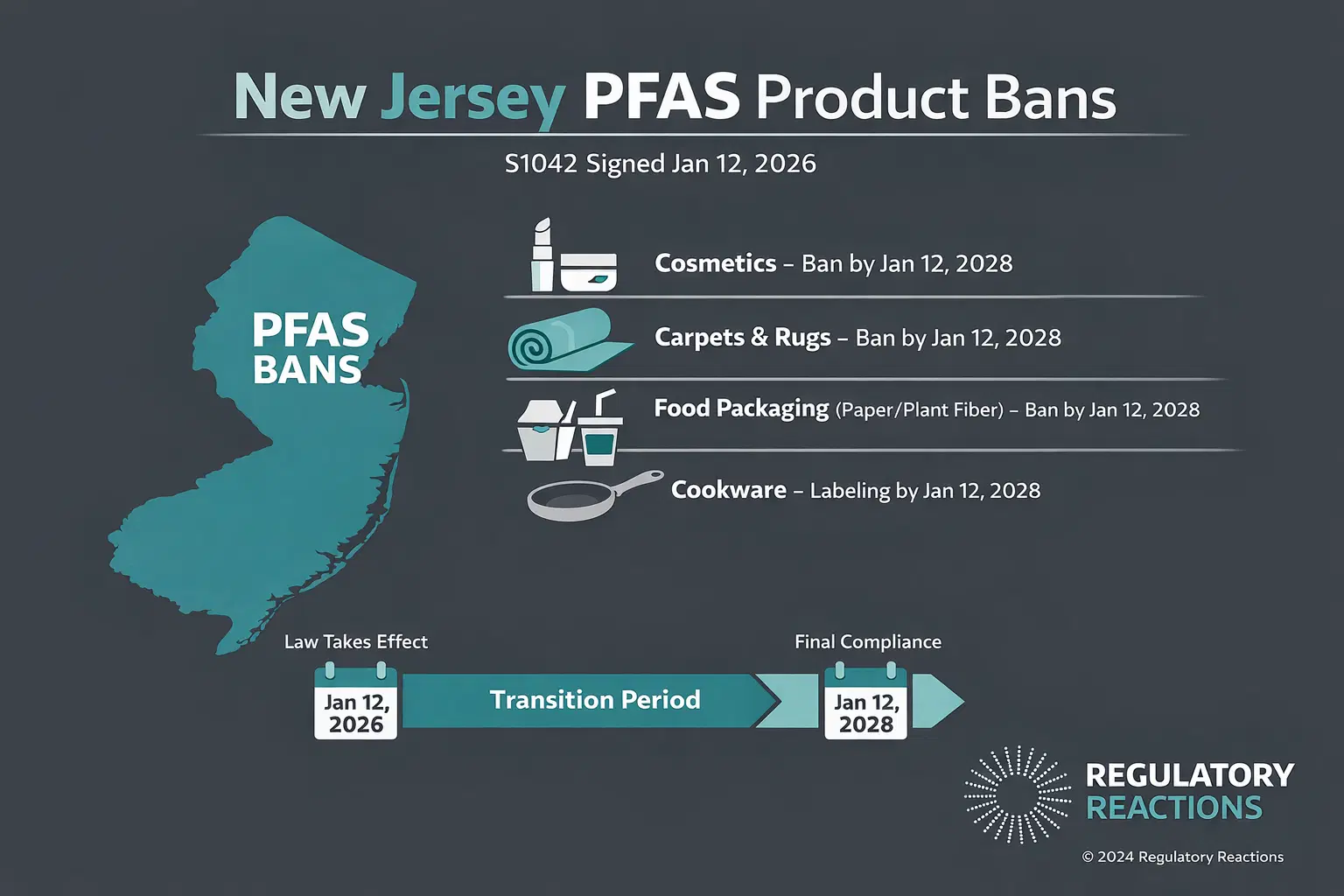
Trenton, NJ, US, January 2026 — New Jersey has officially joined the front ranks of states cracking down on “forever chemicals” when Governor Phil Murphy signed New Jersey Senate Bill 1042 into law on 12 January 2026, marking a decisive shift in how the state regulates per- and polyfluoroalkyl substances (PFAS) in consumer products.
The new statute—formally known as the Protecting Against Forever Chemicals Act—moves beyond traditional water contamination controls and instead targets PFAS at the source: the products sold on store shelves. PFAS, a class of highly persistent synthetic chemicals used for their stain-resistant, grease-proof, and water-repellent properties, have been linked to environmental persistence and potential human health risks. Lawmakers say eliminating intentionally added PFAS in everyday goods is a necessary next step.
The law establishes a clear compliance timeline. While it took effect upon signing in January 2026, the most significant prohibitions begin January 12, 2028, giving manufacturers and retailers a two-year transition window. After that date, it will be unlawful to sell, offer for sale, or distribute certain products in New Jersey if they contain intentionally added PFAS.
Among the products being banned in New Jersey if they contain intentionally added PFAS are cosmetics (excluding soap), carpets and fabric treatments, and food packaging made predominantly from paper or plant-based fibers. For cookware, rather than an outright ban, the law requires clear labeling of products containing PFAS in handles or food-contact surfaces, with notices in both English and Spanish.
New Jersey’s move follows a growing wave of state-level action. Minnesota, for example, recently enacted “Amara’s Law,” phasing in PFAS-product restrictions beginning in 2025 and expanding through 2032. Maine has adopted a broad reporting and prohibition framework with a near-total ban by 2030 unless uses are proven unavoidable, and both Colorado and California have restricted PFAS in categories such as food packaging and textiles. Unlike some of the other states, New Jersey, however, has yet to ban PFAS in plastic packaging.
For manufacturers selling into New Jersey — particularly national brands distributing widely — the 2028 deadline means compliance planning must start now. Companies will need to identify PFAS in product formulations, reformulate or source alternatives, and update labeling and documentation systems well before the enforcement date. Given that many other states and countries already implemented these bans, product brand owners may need to prioritize and map out a national/international strategy rather than reacting to each specific ban in the various states. Products already compliant with PFAS requirements in other states or countries could benefit competitively. Given that many jurisdictions have banned or started the process to ban PFAS in these products, the PFAS ban trend shows no sign of slowing down and will likely spread beyond these jurisdictions and other products.
Consolidated PFAS Product Restriction Comparison
| Product Category | New Jersey | Other States With Active Restrictions | International (France / EU / New Zealand / Canada) |
|---|---|---|---|
| Cosmetics | Ban – Jan 12, 2028 (PFAS class – intentionally added) |
|
|
| Carpets & Rugs | Ban – Jan 12 2028 (PFAS class – intentionally added) |
|
|
| Fabric Treatments | Ban – Jan 12 2028 (PFAS class – intentionally added) |
|
|
| Food Packaging (paper/plant fiber) | Ban – Jan 12 2028 (PFAS class – intentionally added) |
|
|
| Cookware | Labeling – Jan 12 2028 (PFAS disclosure) |
|
|