



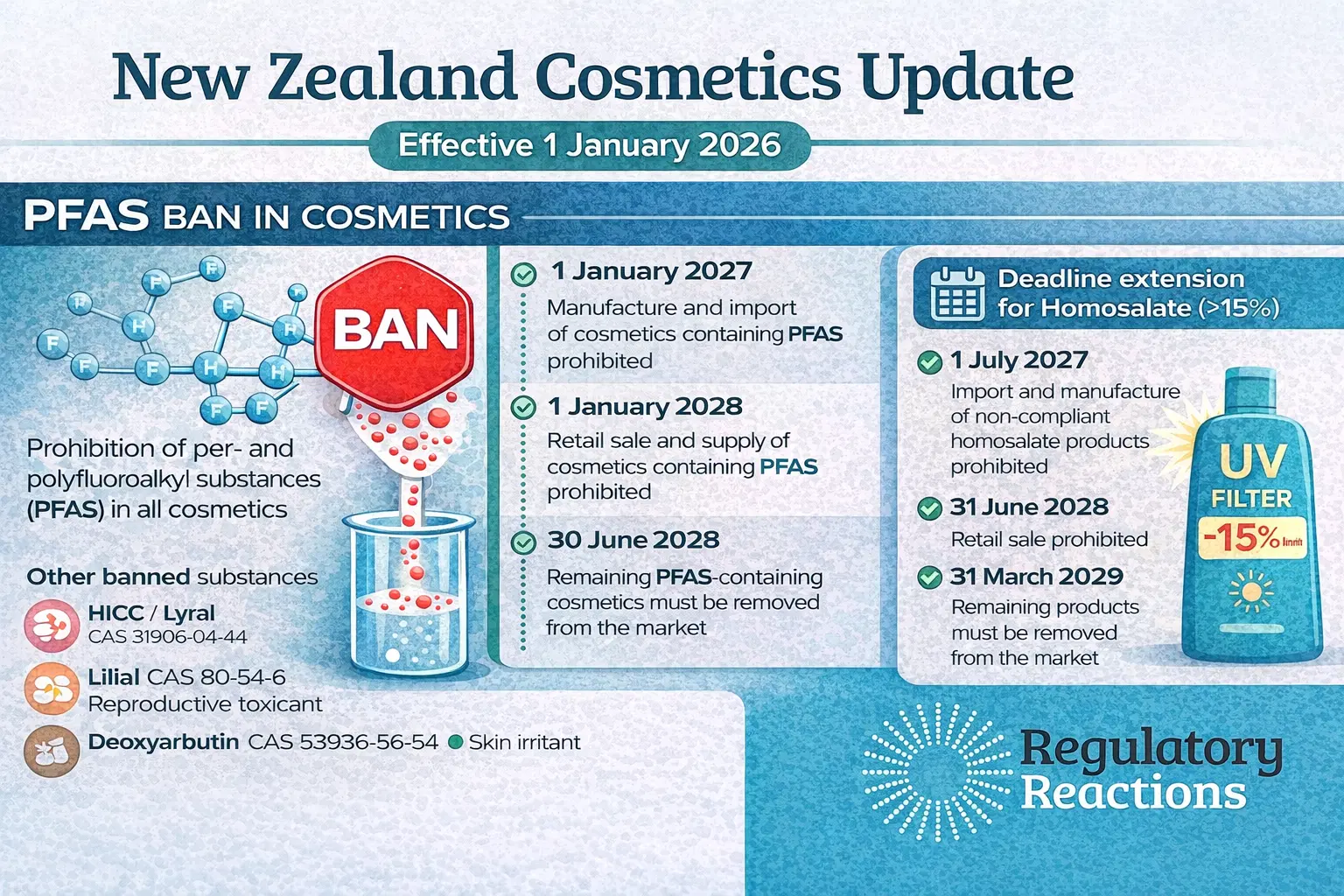
Wellington, NZ, January 2025 - The new year rings in new chemical prohibitions and restrictions for cosmetics in New Zealand as revisions to the Cosmetic Products Group Standard (“Group Standard”) took effect on 1 January 2026. Revised in 2024, the Group Standard now bans PFAS, butylphenyl methylpropional (Lilial), hydroxyisohexyl 3-cyclohexene carboxaldehyde (HICC/Lyral), and deoxyarbutin. It also introduces new limits affecting homosalate and requires fragrances used in cosmetics to comply with the 50th amendment of the IFRA fragrance standards, replacing the 39th amendment referenced in the previous version of the Group Standard. The rule is administered by the Environmental Protection Authority under the Hazardous Substances and New Organisms Act 1996.
PFAS ban
The most significant regulatory change is the prohibition of the class of per- and polyfluoroalkyl substances (PFAS) in cosmetics. The Group Standard defines PFAS broadly as substances containing at least one fully fluorinated methyl or methylene carbon atom, capturing a wide class of fluorinated chemicals historically used in cosmetics to improve water resistance, durability, and product spreadability.
To allow time for reformulation and supply chain adjustments, New Zealand established a staged transition timeline:
1 January 2027 - Manufacture and import of PFAS-containing cosmetics prohibited
1 January 2028 - Retail sale of PFAS-containing cosmetics prohibited
30 January 2030 - Remaining PFAS cosmetics must be removed from the market
“The changes help ensure cosmetic products sold in New Zealand remain safe for people while reducing environmental risks from persistent chemicals,” said Dr. Shaun Presow, Manager of Hazardous Substances Reassessments. “Updating the Cosmetic Products Group Standard ensures the regulatory framework reflects evolving science and international safety standards.”
France and several US states such as California, Colorado, Maine, Maryland, Minnesota, New Jersey, New Mexico, Oregon, Rhode Island, and Washington have all banned PFAS in cosmetics.
Other notable chemical bans
In addition to PFAS, Dr. Presow said “[t]he main changes we’ve made to the rules include updating the lists of ingredients that can be used in cosmetic products, including banned ingredients." Banned substances include the following:
Hydroxyisohexyl 3-cyclohexene carboxaldehyde (HICC / Lyral) - due to skin allergen
Lilial (Butylphenyl Methylpropional or p-BMHCA)
Deoxyarbutin - due to potential conversion to hydroquinone, which may cause permanent skin discoloration, severe inflammation, and irritation
These substances were added to the prohibited list of chemicals due to their inclusion on the EU Cosmetics Regulation’s prohibited list (Annex II), following classifications as carcinogenic, mutagenic, or toxic to reproduction (CMR) under EU chemical classification rules. Lyrall remains banned in New Zealand despite its incorrect inclusion on both the prohibited and restricted lists.
“We’ve strengthened the rules around certain ingredients in cosmetic products to continue ensuring the safety of these products and to align with international developments.” Dr. Presow commented.
New Zealand, however, opted to follow Australia instead of the EU in restricting, rather than banning, the use of zinc pyrithione in cosmetics. New Zealand permits the use of the chemical up to 1% in rinse-off hair products such as anti-dandruff shampoos. However, usage in other applications and children’s products for ages 3 or below is still prohibited.
New Phase-out Deadlines for Homosalate
Another key revision is the extension on the phase-out deadlines for homosalate. As of 1 July 2027, cosmetics containing greater than 15% of homosalate would be prohibited from being manufactured or imported into the country, while retail sale and supply of the same products must cease by 1 July 2028. By 31 March 2029, all remaining products containing more than 15% of homosalate must be removed from the market.
The 15% threshold in New Zealand deviates from the EU restrictions. The maximum threshold for homosalate has been reduced to 7.34% in face products (excluding sprays) in the EU since 2025. ASEAN member nations (Brunei, Indonesia, Malaysia, Myanmar, Philippines, Singapore, Thailand, and Vietnam) have also embraced the EU’s restrictions, while the UK’s restrictions are capped at 10%.
Implications for Cosmetic Manufacturers
“Anyone importing or making cosmetics that contain a hazardous component must meet the new requirements. Hazardous substances can also include natural or organic ingredients,” recommends Dr. Presow. “The changes require products that are not hazardous, but which contain a hazardous ingredient, to comply with the group standard. This makes it easier to ensure the safety of these products and enforce the rules for banned and restricted ingredients.”
Companies manufacturing or importing cosmetics into New Zealand should begin reviewing product formulations and supply chains to prepare for the new requirements.
Key compliance actions include the following:
identifying PFAS and other restricted chemicals in product formulations
confirming ingredient compliance with updated schedules
evaluating reformulation strategies for affected products
preparing for upcoming phase-out deadlines
Given the convergence of some of these bans and restrictions in other countries, global brands might benefit from a global compliance strategy rather than just focusing on New Zealand. New Zealand’s brands already in compliance with the new revisions in the Group Standard may also find easy market access when exporting to other countries.
New Zealand Cosmetics Compliance Milestones
| Chemical / Requirement | Compliance Date | Milestone |
|---|---|---|
| Revised Cosmetic Products Group Standard | 1 January 2026 | Updated chemical prohibitions, restrictions, fragrance standard requirements, and expanded compliance scope became effective in New Zealand. |
| PFAS in cosmetics | 1 January 2027 | Manufacture and import of cosmetics containing PFAS prohibited. |
| PFAS in cosmetics | 1 January 2028 | Retail sale and supply of cosmetics containing PFAS prohibited. |
| PFAS in cosmetics | 30 June 2028 | Remaining PFAS-containing cosmetics must be removed from the market and disposed of. |
| Homosalate above 10% | 1 July 2027 | Manufacture and import of cosmetic products containing more than 10% homosalate prohibited. |
| Homosalate above 10% | 1 July 2028 | Retail sale and supply of cosmetic products containing more than 10% homosalate prohibited. |
| Homosalate above 10% | 31 March 2029 | Remaining cosmetic products containing more than 10% homosalate must be removed from the market. |
| IFRA fragrance standards | 1 January 2026 | Fragrances in cosmetics must comply with the 50th amendment to the IFRA standards, replacing the 39th amendment in the previous Group Standard. |
| Hazardous ingredient scope expansion | 1 January 2026 | Cosmetics containing a hazardous ingredient must comply with the Group Standard even if the finished product itself is not classified as hazardous. |