
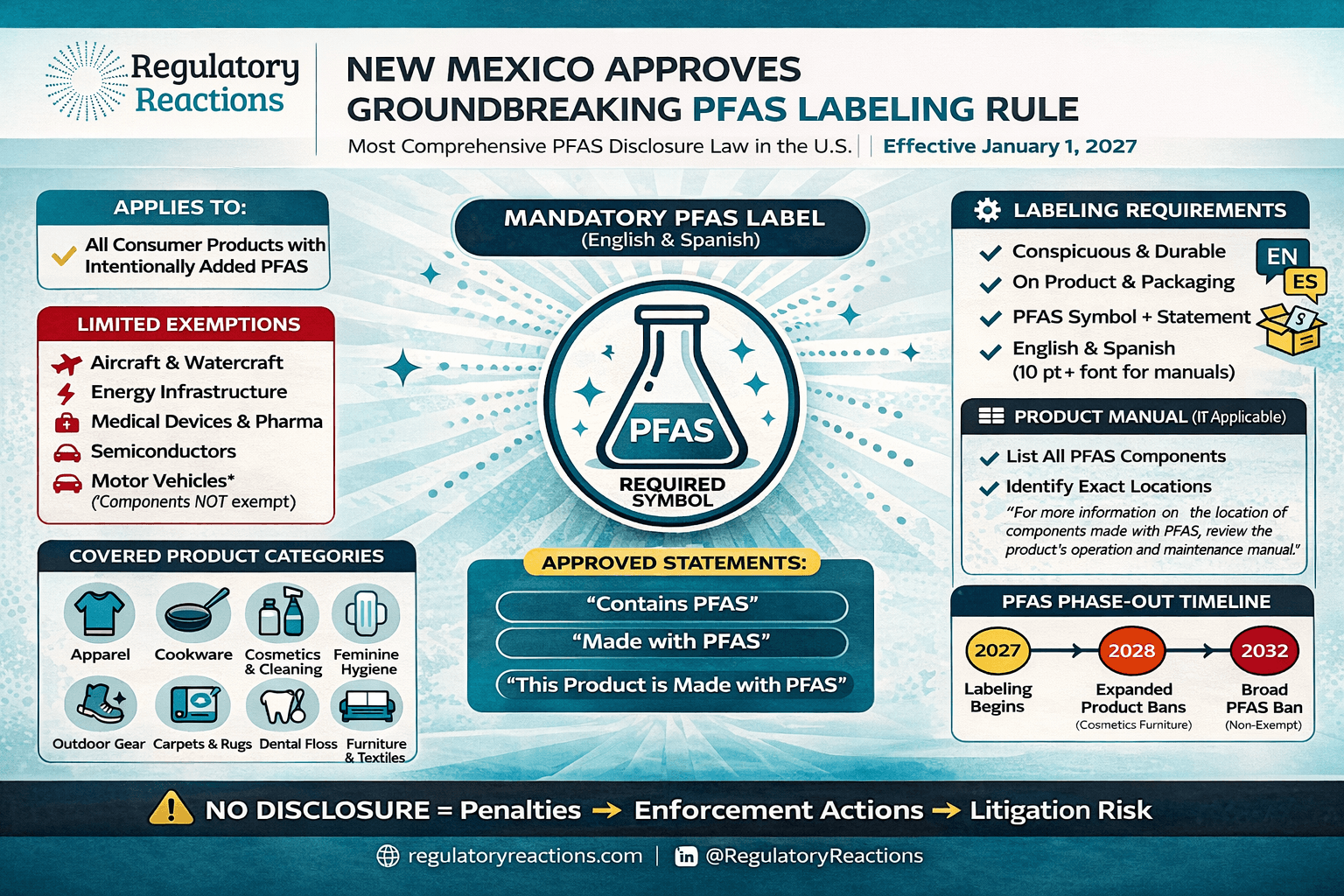
Santa Fe, New Mexico, US, March 2026 — The New Mexico Environment Department (NMED) has approved expansive new requirements mandating consumer-facing labeling for products containing intentionally added per- and polyfluoroalkyl substances (PFAS), creating one of the most comprehensive disclosure regimes in the United States.
Implementing the PFAS Protection Act (HB212), which was signed into law in 2025, the rule applies broadly to consumer products containing intentionally added PFAS. While the final rule text has not yet been published, NMED is expected to have adopted provisions largely consistent with the revised proposal presented during the February 2026 public hearing.
Scope of consumer products & exemption waiver
The new rule is expected to apply to a wide universe of consumer products, supported by a broad definition of “consumer,” which includes individuals, corporations, and state entities acquiring goods or services.
Products may avoid PFAS disclosure only if all three conditions are met:
PFAS-containing components never come into direct contact with consumers during normal use;
The product falls within specified exempt categories; and
The manufacturer obtains a formal waiver from NMED.
Potential exempt categories include:
Aircraft and watercraft
Energy generation and distribution equipment
Fungicide, pesticides, and rodenticides or similar regulated chemicals
Medical devices, pharmaceuticals, and veterinary products
Manufacturing equipment and semiconductors
Certain fluoropolymer-containing containing products
Motor vehicles are parts of the exempted categories, but components in vehicles such as textiles and refrigerants are still applicable.
To obtain a waiver/ exemption, manufacturers must submit:
Product identification details (e.g., SKU or UPC)
PFAS identity, function and concentration (with CAS numbers)
Justification for why labeling should not apply
Labeling requirements
The rule introduces highly prescriptive labeling requirements, including:
Labels must be conspicuous, durable, and visible at point of sale
Must appear on both product and packaging, where applicable
Required in English and Spanish
Must include a PFAS symbol (the word “PFAS” inside an Erlenmeyer flask outline)
Approved wording may include:
“Contains PFAS”
“Made with PFAS”
“This product is made with PFAS”Alternative labeling
Additional Requirements for Complex Durable Goods
For complex or durable products, disclosure extends beyond labeling. Product documentation must include the PFAS symbol and may include the disclosure statement similar to the label. Specification sheets must include the statement: “For more information on the location of components made with PFAS, review the product’s operation and maintenance manual.” Manuals or product sheets must identify: all PFAS-containing components, the location of the parts or materials with intended added PFAS within the products,
All required disclosures must be presented in 10-point font or larger.
Alternative Labeling Pathway
Manufacturers may use another state’s PFAS labeling regime in lieu of New Mexico’s requirements, but only with prior approval. To obtain approval, companies must: Submit the alternative label and demonstrate equivalency with New Mexico requirements.
NMED must respond within 90 days to confirm acceptance.
Compliance Timeline Aligned with PFAS Phase-Out
1 January 2027 — Labeling and disclosure requirements take effect
2027 — Initial product bans (e.g., cookware, food packaging)
2028 — Expanded bans (e.g., cosmetics, furniture, carpets)
2032 — Broad prohibition of PFAS in non-exempt products
The labeling requirement acts as a transitional compliance tool ahead of full phase-out.
Comparison with other US states
New Mexico’s rule stands out for its cross-product scope but other states also have PFAS disclosure for some products. By comparison, California, Colorado, Connecticut, New Jersey require PFAS disclosure for cookware while disclosure for outdoor apparel are mandated by California, Colorado, Connecticut. Connecticut currently has the broadest multi-category disclosure rule. However, New Mexico is expected to surpass all states in scope and prescriptive detail.
Implications for industry
The rule signals a shift from targeted restrictions to full supply chain transparency as its impact extends beyond labeling. To properly label, companies must identify PFAS across products and components, which will require testing product testing, obtaining supplier declarations, and/or auditing supply chain audits. Failure to disclose PFAS may lead to administrative enforcement actions for inaction, or penalties for deceptive practices or even potential private litigation. At the same time, labeling PFAS may also triggers detailed reporting obligations in New Mexico and other jurisdictions and increase exposure to product safety claims across states who have banned PFAS.
| Product Type | States + Compliance Timeline | Language Requirement | Specific Phrases |
|---|---|---|---|
| All Consumer Products (intentionally added PFAS) | New Mexico — 1 January 2027 | New Mexico: English & Spanish | New Mexico: “Contains PFAS” / “Made with PFAS” / “This product is made with PFAS” + PFAS symbol |
| Apparel | Connecticut — 1 July 2026 New Mexico — 1 January 2027 |
Connecticut: Not specified (English likely mandatory) New Mexico: English & Spanish |
Connecticut: “Contains PFAS” / “Made with PFAS” / “Made with PFAS chemicals” New Mexico: “Contains PFAS” / “Made with PFAS” |
| Cookware | California — 1 January 2024 Colorado — 1 January 2024 (ended 1 January 2026) Connecticut — 1 July 2026 New Mexico — 1 January 2027 New Jersey — 12 January 2028 |
California: Not specified (English likely mandatory) Colorado: Not specified (English likely mandatory) Connecticut: Not specified (English likely mandatory) New Mexico: English & Spanish New Jersey: English & Spanish |
California: “This product contains:” + website disclosure Colorado: “For more information about PFAS chemicals in this product, visit” Connecticut: “Contains PFAS” New Mexico: “Contains PFAS” New Jersey: “This product contains PFAS” |
| Cosmetics | Connecticut — 1 July 2026 New Mexico — 1 January 2027 |
Connecticut: Not specified (English likely mandatory) New Mexico: English & Spanish |
Connecticut: “Contains PFAS” / “Made with PFAS chemicals” New Mexico: “Contains PFAS” |
| Feminine Hygiene Products | Connecticut — 1 July 2026 New Mexico — 1 January 2027 |
Connecticut: Not specified (English likely mandatory) New Mexico: English & Spanish |
Connecticut: “Contains PFAS” / “Made with PFAS chemicals” New Mexico: “Contains PFAS” |
| Outdoor Apparel (Severe Wet Conditions) | California — 1 January 2025 Colorado — 1 January 2025 to 31 December 2027 Connecticut — 1 January 2026 |
Not specified (English likely mandatory) | California / Colorado / Connecticut: “Made with PFAS chemicals” |
| Turnout Gear (Firefighting) | Connecticut — 1 January 2026 | Not specified (English likely mandatory) | Connecticut: Written notice that product contains intentionally added PFAS + reason for use |