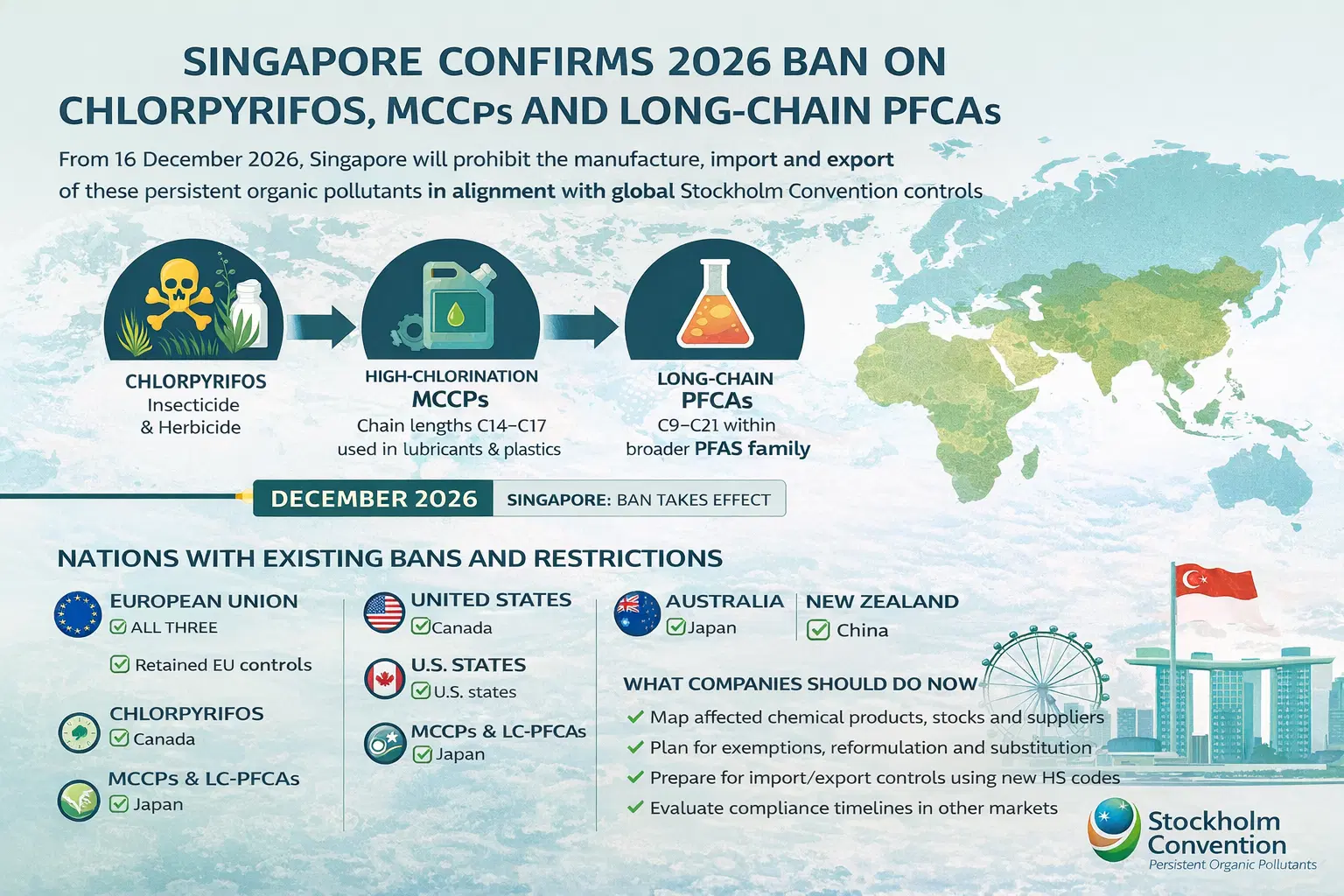
Singapore, January 2026 — Singapore will prohibit the manufacture, import and export of chlorpyrifos, medium-chain chlorinated paraffins (MCCPs) with high chlorine content, and long-chain perfluorocarboxylic acids (LC-PFCAs) from 16 December 2026, aligning domestic controls with new global obligations under the Stockholm Convention.
The update was confirmed in a circular issued by the National Environment Agency (NEA) following the formal Depositary Notification circulated on 16 December 2025. The chemicals were listed in Annex A of the Convention for elimination at the twelfth Conference of the Parties in April–May 2025, subject to narrowly defined exemptions.
Substances targeted for phase-out
The measures apply to:
Chlorpyrifos, an organophosphate insecticide and herbicide;
Medium-chain chlorinated paraffins (MCCPs) (C14–C17) with chlorination levels ≥ 45% by weight, used in lubricants, metalworking fluids, coatings and plastics; and
Long-chain perfluorocarboxylic acids (LC-PFCAs) (C9–C21), their salts and related compounds, part of the wider PFAS family.
From December 2026, the manufacture, import and export of these substances — and products containing them — will no longer be permitted in Singapore. Existing stocks imported before that date may continue to be depleted.
How Singapore aligns with global restrictions
Singapore’s announcement follows a growing list of national and regional bans or phase-outs already in force or underway:
Chlorpyrifos
European Union: Approval for chlorpyrifos and chlorpyrifos-methyl was not renewed, effectively banning their use in plant protection products since 2020.
United States: US EPA has revoked food tolerances for chlorpyrifos, eliminating most agricultural uses, with additional state-level bans in jurisdictions such as California, Hawaii, New York and Oregon.
Canada: Progressive cancellations and restrictions have removed most agricultural uses, with limited exceptions under review.
Australia and New Zealand: Uses have been significantly restricted following risk assessments citing human health and environmental concerns.
MCCPs (high chlorination)
European Union: MCCPs meeting the Stockholm definition are controlled under POPs legislation, with restrictions on manufacture, placing on the market and use, including in mixtures and articles.
United Kingdom: Retained EU-derived POPs controls following Brexit, restricting MCCPs in line with the Convention.
Japan: MCCPs are subject to strict controls under the Chemical Substances Control Law as persistent and bioaccumulative substances.
LC-PFCAs
European Union: LC-PFCAs are restricted under the POPs framework, complementing broader PFAS controls under REACH.
United States: Several LC-PFCAs are regulated under TSCA and drinking water programs, with additional state-level bans on PFAS in products.
Canada: LC-PFCAs are listed as toxic under CEPA, with prohibitions and reporting requirements already in place.
China: Certain PFAS, including long-chain variants, are subject to production and use restrictions following Stockholm listings.
All three substances are also proposed to be phased out in the Philippines as well.
Exemptions and next steps
While the Stockholm Convention allows specific, time-limited exemptions, NEA confirmed it is assessing whether any such exemptions are relevant to Singapore’s domestic industry. Further guidance will be issued once that review is complete.
Trade and compliance implications
NEA has published a detailed list of affected Harmonised System (HS) and Product Codes, covering pesticides, lubricants, paints, plasticisers and laboratory reagents. All related import and export permit applications must use the specified codes and will be subject to agency approval through TradeNet®. 2026-01-26-updates-on-the-phase…
With Singapore joining a widening group of jurisdictions eliminating these substances, companies are being urged to accelerate substitution planning, review inventories and engage supply chains well ahead of the December 2026 deadline.