
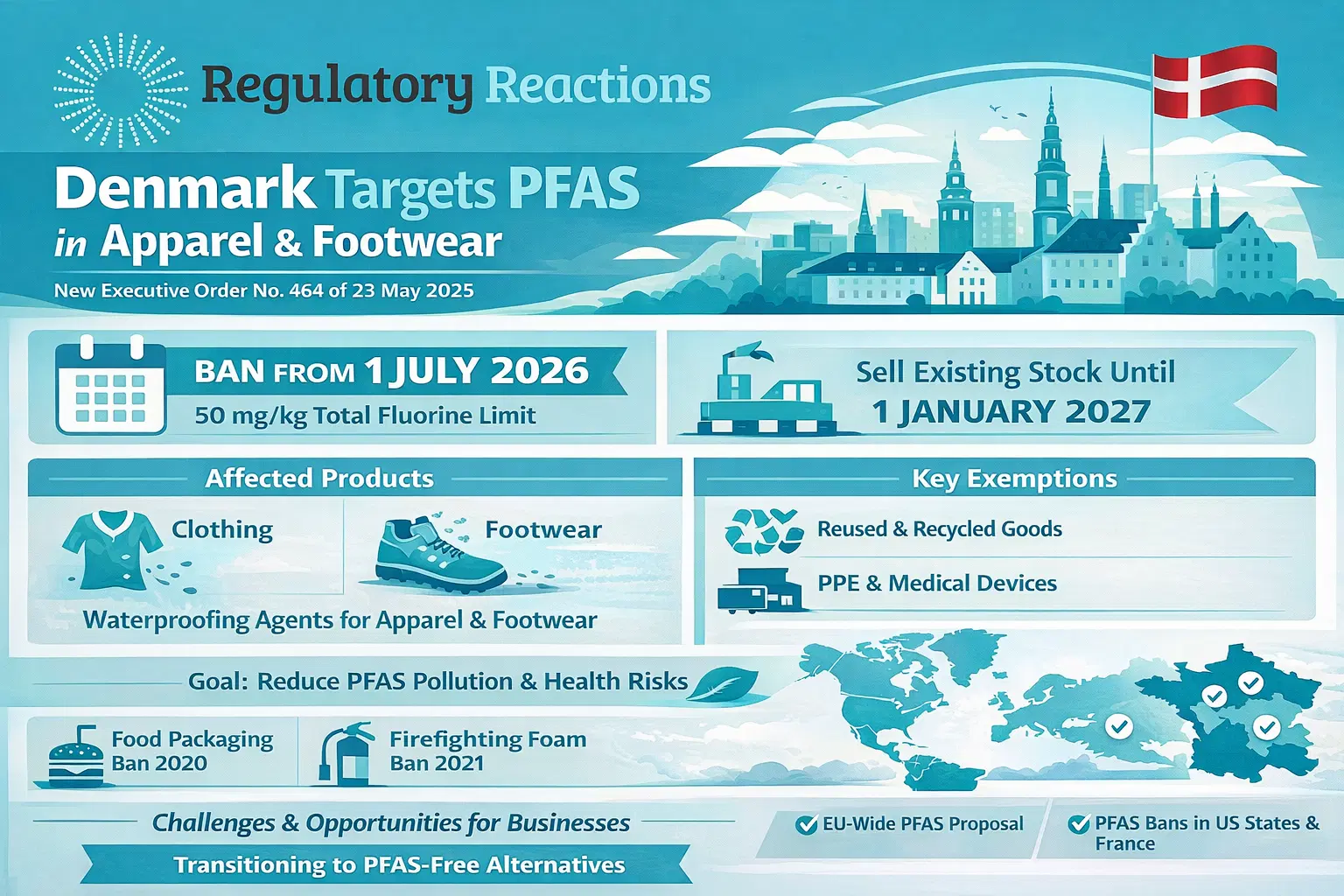
Copenhagen, Denmark, EU, 23 May 2025 — Denmark has expanded its national restrictions on per- and polyfluoroalkyl substances (PFAS) with Executive Order No. 464 of 23 May 2025, banning the import and consumer sale of clothing, footwear, and waterproofing agents for private use when they contain PFAS at 50 mg fluorine/kg or more. The ban starts on 1 July 2026 while businesses may sell existing stock until 1 January 2027.
Manufacturers have historically used PFAS in textiles to create water-repellent and stain-resistant coatings, particularly in outdoor apparel and waterproof footwear. Danish regulators adopted the new rule to reduce environmental releases of these persistent chemicals and potential health risks.
Affected chemicals
Denmark uses the same PFAS definition as other EU countries and the Organisation for Economic Co-operation and Development (OCED), which is any substance that contains at least one fully fluorinated methyl (CF-3 ) or methylene (CF-2 ) carbon atom, without any hydrogen, chlorine, bromine, or iodine atoms bonded to it.
The Order narrows the scope of PFAS chemicals by excluding non-polymeric substances that only contain a –CF₃ or –CF₂– moiety (often called “perfluoroalkyl ethers exclusion”). Specifically, any CF 3 -X or X-CF 2 -Xˈ, where:
X = -OR or -NRRˈ and
Xˈ = a methyl group (-CH 3 ), a methylene group (-CH 2 -), an aromatic group, a carbonyl group (-C(O)-), -ORˈˈ, -SRˈˈ or -NRˈˈRˈˈˈ,
and where R/Rˈ/Rˈˈ/Rˈˈˈ is a hydrogen atom (-H), a methyl group (-CH 3 ), a methylene group (-CH2-), an aromatic group or a carbonyl group (-C(O)-).
Unlike many PFAS product bans that do not contain a de minimis threshold, Denmark’s ban only triggers once the products contain 50 mg fluorine per kilogram (50 ppm total fluorine) or greater.
Affected products & product exemptions
While the Order restricts the import and sale to consumers of clothing, footwear, and waterproofing agents, the ban exempts reused and recyled clothing and footwear, personal protective equipment (PPE), medical devices, and products transiting through Denmark. These products often rely on PFAS-based coatings to create durable water-repellent finishes.
Expansion on Denmark’s Previous PFAS Restrictions
This is not Denmark’s first PFAS product ban. In 2020, Denmark barred the marketing of paper and cardboard food-contact materials made with PFAS under its Executive Order No. 681 (“food-contact-materials order”), making it one of the first EU countries to act directly against PFAS in consumer packaging. That Order targets PFAS used as grease-resistant coatings in products such as fast-food wrappers, takeaway containers, and bakery packaging, etc. Denmark also adopted Executive Order No. 1442 of 17 June 2021, which restricts the use of PFAS-containing firefighting foams used for training purposes.
Part of broader EU and International trend
This Order follows a French law that bans PFAS in cosmetics, clothing textiles, footwear, waterproofing products, ski wax, which took effect in January 2026. The EU is currently considering a universal PFAS restrictions ban, which was proposed by Denmark, Germany, the Netherlands, Sweden, and Norway. In the United States, several states, including California, New York, Maine, Vermont, Rhode Island, Connecticut, and Illinois, have adopted bans on apparel or textile articles containing intentionally added PFAS. Other states such as Minnesota, Colorado, Washington, and Vermont have focused on PFAS used in fabric treatments and stain- or water-resistant coatings, which are commonly applied to textiles and outdoor apparel. Rhode Island, like France and Denmark, has a ban on footwear.
Challenges and opportunities for companies
The expanding and fractured network of PFAS textile restrictions presents both compliance challenges and strategic opportunities for companies operating in global supply chains.
Companies must therefore audit their supply chains to ensure products do not include PFAS in textile coatings, waterproofing treatment, or stain-resistant finishes. The audit may include supplier declarations, material certification, or product testing - all of which may incur additional cost for compliance.
Despite these challenges, companies that can quickly pivot may gain a business advantage. Brands that could adopt PFAS-free supply chains may gain competitive advantages as retailers, regulators, and consumers demand safer materials. Transitioning away from PFAS now may reduce exposure to future regulations as more jurisdictions consider these similar PFAS product bans.