



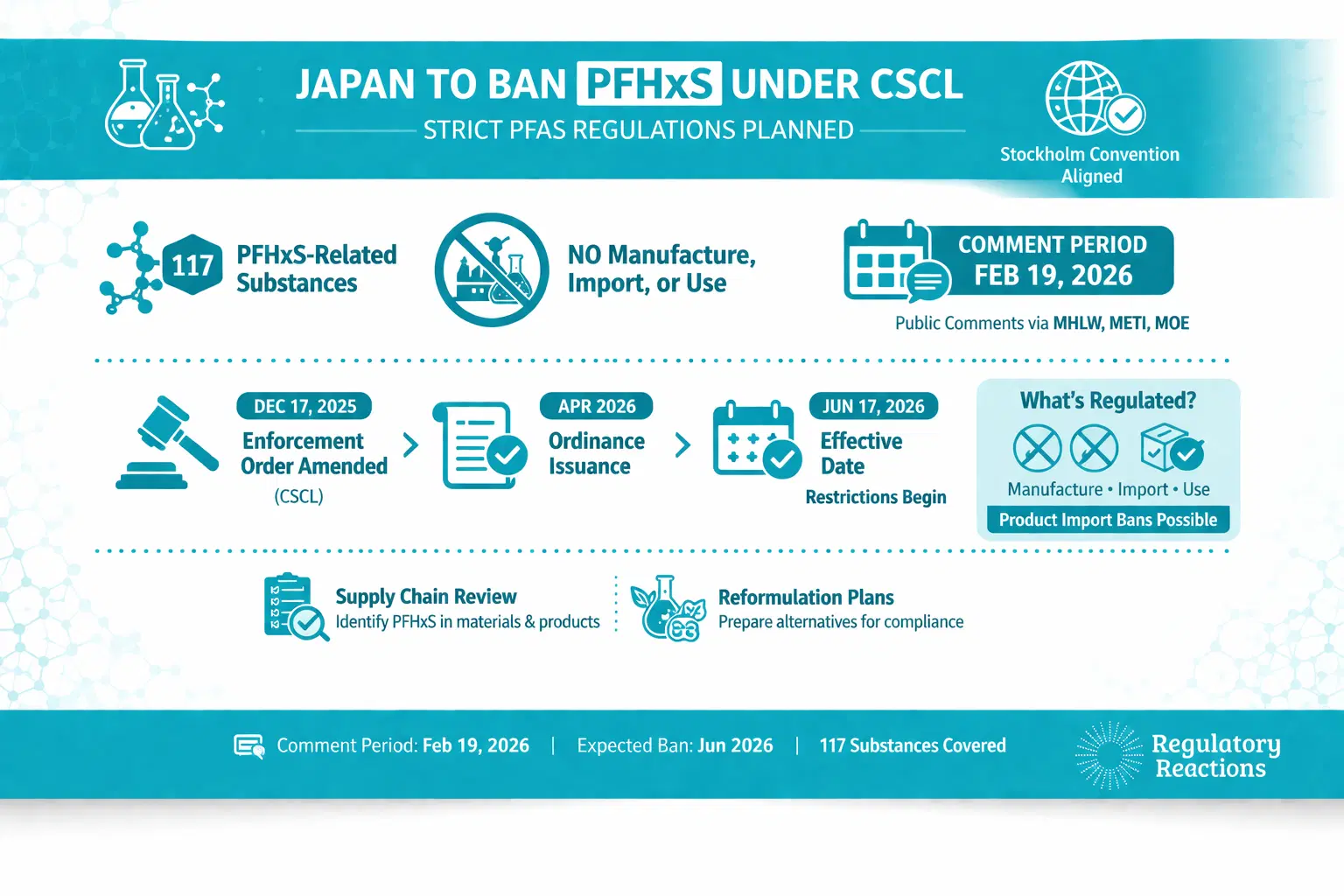
Tokyo, Japan, January 2026 — Japan’s Ministry of Health, Labour and Welfare (MHLW), Ministry of Economy, Trade and Industry (METI), and Ministry of the Environment (MOE) have jointly issued a draft ministerial ordinance to formally designate 117 perfluorohexanesulfonic acid (PFHxS) substances as Class I Specified Chemical Substances under the Chemical Substances Control Law (CSCL).
The draft, released on January 21, 2026, is open for public consultation through February 19, 2026.
Alignment with Stockholm Convention
The proposed designation follows the global decision adopted at the last Conference of the Parties to the Stockholm Convention in June 2023, where PFHxS and its related compounds were added for elimination as persistent organic pollutants (POPs).
Japanese authorities — including advisory councils under MHLW, METI, and MOE — subsequently concluded that PFHxS meets the criteria for Class I designation due to its persistence, bioaccumulation potential, and long-term toxicity.
Japan had already amended the CSCL Enforcement Order on December 17, 2025 to include PFHxS-related substances. The current ordinance implements that amendment by defining the specific substances subject to control.
Scope of PFHxS-Related Substances
The draft defines PFHxS-related substances broadly as compounds containing:
A perfluoroalkyl sulfonyl group (C6), or
A perfluoroalkyl sulfinyl oxy group (C6)
These substances may degrade or transform into PFHxS or structurally related perfluoroalkanesulfonic acids with six carbon atoms.
The annex to the draft ordinance identifies 117 individual substances captured under this definition.
Timeline
Public comment deadline: February 19, 2026
Expected promulgation: April 2026
Expected effective date: June 17, 2026
Regulatory and industry impact
Designation as a Class I Specified Chemical Substance triggers Japan’s highest level of chemical control under CSCL. Once finalized:
Manufacture, import, and use of PFHxS-related substances will be prohibited in principle
Products containing these substances may also be banned from import, depending on future government specifications
These controls apply to substances deemed persistent, bioaccumulative, and toxic to human health or ecosystems.
The proposed regulation reinforces Japan’s alignment with global PFAS restrictions and signals continued tightening of controls on long-chain perfluoroalkyl substances.