
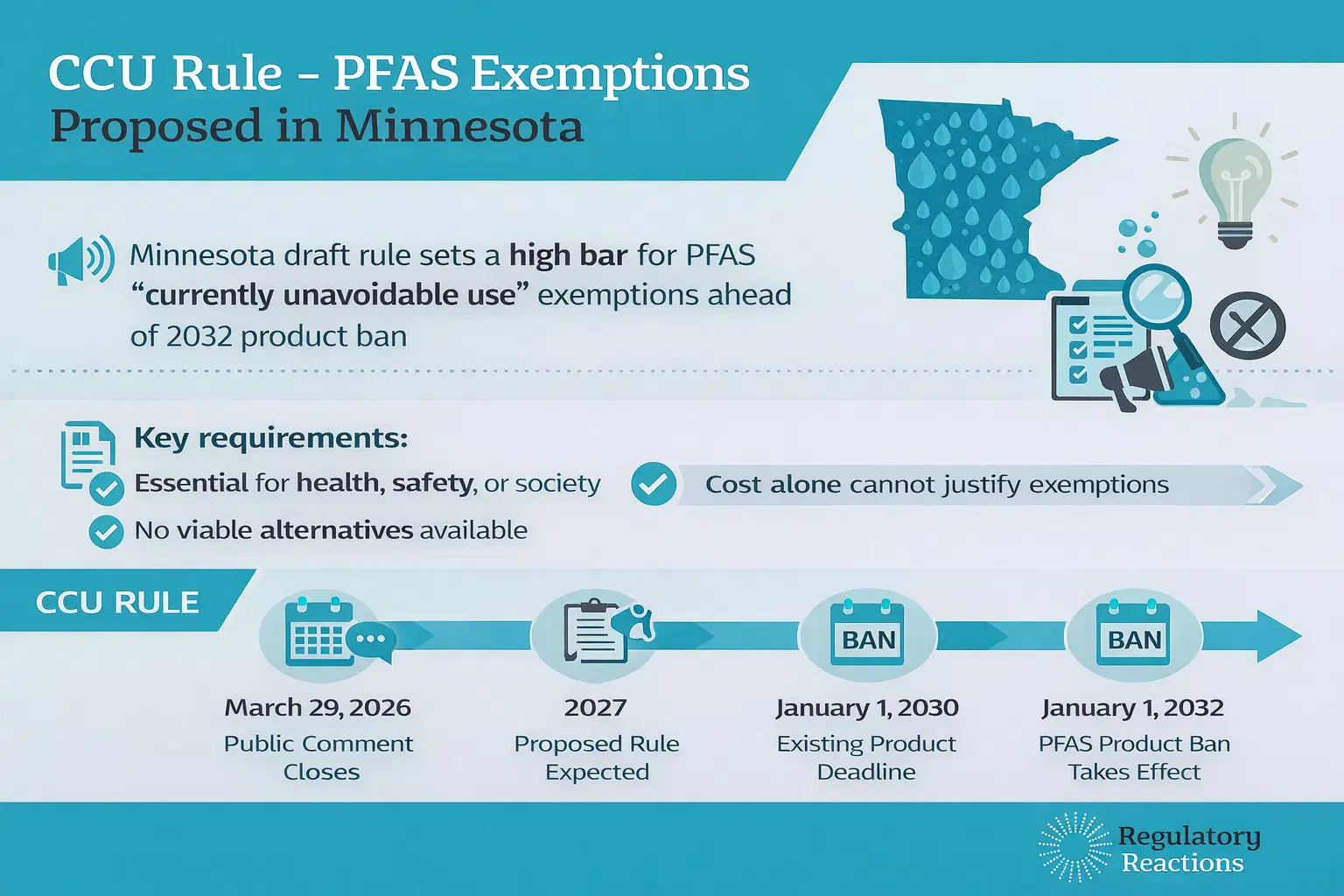
St. Paul, Minnesota, US, March 2026 — The deadline for the public comments is ending soon for Minnesota’ consultation on its unavoidable use rule, one of the most consequential PFAS regulatory frameworks in the United States.
The Minnesota Pollution Control Agency (MPCA) has outlined a proposed framework for determining “currently unavoidable use” (CUU)—a narrowly defined, evidence-based pathway that would allow certain PFAS uses to remain on the market where they are deemed essential and lack viable alternatives.
Promulgated under Minnesota’s PFAS in Products law (Amara’s Law), the proposed rule seeks to define both substantive criteria and procedural requirements, including who may apply for a waiver, when applications must be submitted, and how determinations will be made.
Core framework: a high bar for exemptions
The draft proposal confirms that CUU determinations will be limited and highly scrutinized, not broad exemptions.
To qualify, manufacturers must demonstrate that:
The PFAS use is essential for health, safety, or the functioning of society
No reasonably available alternatives exist—including chemical substitutes, material changes, or product redesign
Substitution would result in significant negative impacts to public health, safety, or critical infrastructure
MPCA further clarifies that alternatives already in use in equivalent products are presumed to be “reasonably available.”
The agency defines a PFAS alternative broadly, covering not only substitute chemicals but also non-chemical solutions, manufacturing changes, and product redesigns. However, the proposal lacks a clear methodology for determining functional equivalency, leaving a key area of uncertainty.
Critically, cost alone is not a valid justification for continued PFAS use. The framework prioritizes performance, availability, and societal need over economic convenience.
MPCA is actively seeking stakeholder feedback on three core definitions: essentiality, alternatives and availability
Eligible applicants
The draft proposal makes clear that eligibility to apply is broad, but approvals are narrow and applicant-specific. A CUU request may be submitted by Individual manufacturers, groups of manufacturers (e.g., industry coalitions), or authorized representatives acting on behalf of manufacturers. However, each CUU determination will be manufacturer-specific (e.g. only applicable to the named applicant(s)). This means:
Approval does not automatically extend to the entire market
Competitors must submit their own applications or be included in a joint submission
Manufacturer identity must align with Minnesota’s PFAS reporting system records
Notably, MPCA indicates that companies may apply for a CUU determination based on an existing positive determination for a similar product within the same product category, raising important questions around how broadly or narrowly product categories will be defined—another area where feedback is being requested.
CUU application process
The proposed process introduces a structured, quasi-adjudicatory review:
Submission of CUU request
Completeness review
30 days to cure deficiencies if incomplete
MPCA technical evaluation
Draft determination issued
30-day public comment period
Applicant rebuttal (30 days)
Final determination
MPCA proposes that an initial positive CUU determination for existing products would last eight years from issuance, while an initial determination for novel products would last five years from issuance. After that, each renewal would last five years from expiration, and the applicant would need to apply for renewal at least one year before the determination expires. The agency says the eight-year initial term for existing products is intended in part to stagger future renewal deadlines and ease administrative burden.
Cost & time
While cost is not a determining factor for eligibility, MPCA is seeking detailed feedback on the practical burden of compliance, including:
Time required to identify PFAS at the material level
Effort needed to compile CUU application dossiers
Cost and feasibility of alternatives assessment
R&D timelines for reformulation and validation
This signals that, in addition to policy outcomes, the agency is also considering the real-world feasibility and resource demands on industry compliance.
Timeline: from draft concepts to 2032 ban
MPCA has outlined a multi-year rulemaking and implementation timeline that companies must track closely:
2026 - Draft rule concepts released with ongoing stakeholder engagement and technical discussions. Public comment period open through March 29, 2026 (4:30 PM CST)
2027 (expected) - Publication of proposed rule language, release of SONAR (Statement of Need and Reasonableness) and formal rulemaking process begins (including hearings and additional comments)
~2028–2029 (anticipated) - Final rule adoption (timeline not yet fixed)
1 January 2030 (proposed milestone) - Suggested deadline to submit CUU applications for existing products on the market. Requests submitted after this date may be treated as “novel products” and deprioritized
January 1, 2032 - Full prohibition takes effect. Products with intentionally added PFAS cannot be sold in Minnesota without an approved CUU determination. No sell-through allowed without approval
MPCA is specifically requesting feedback on whether the 2030 application deadline is reasonable.
Next Steps for Industry
Minnesota’s CUU framework signals a shift toward justification-based compliance, requiring companies to defend continued PFAS use with robust technical evidence. The process resembles the EU REACH authorization model, but on a compressed timeline.
Companies should start taking some actions now rather than waiting for final rule adoption. Immediate actions includes:
Mapping products containing intentionally added PFAS sold in Minnesota
Identify PFAS in materials at the CAS level where possible, either through testing and/or obtaining declarations from suppliers
Begin alternatives assessments, including non-chemical redesign options, in-house and in working with suppliers
Evaluate whether current uses could meet the “essential use” threshold
Align internal data with Minnesota’s PFAS reporting system
For products that could meet the “essential use” threshold, companies should also begin gathering documentation to support:
Performance necessity
Lack of alternatives
Supply chain constraints
Companies should also adopt a multi-state strategy, as similar PFAS restrictions are emerging across different U.S. states and other jurisdictions. Consistency in data, assumptions, and justification will be critical to avoid conflicting regulatory positions.
With no sell-through allowed after 2032 without approval, companies that delay preparation risk losing market access. The CUU pathway is open—but the burden of proof will be high, and the clock is already ticking.