
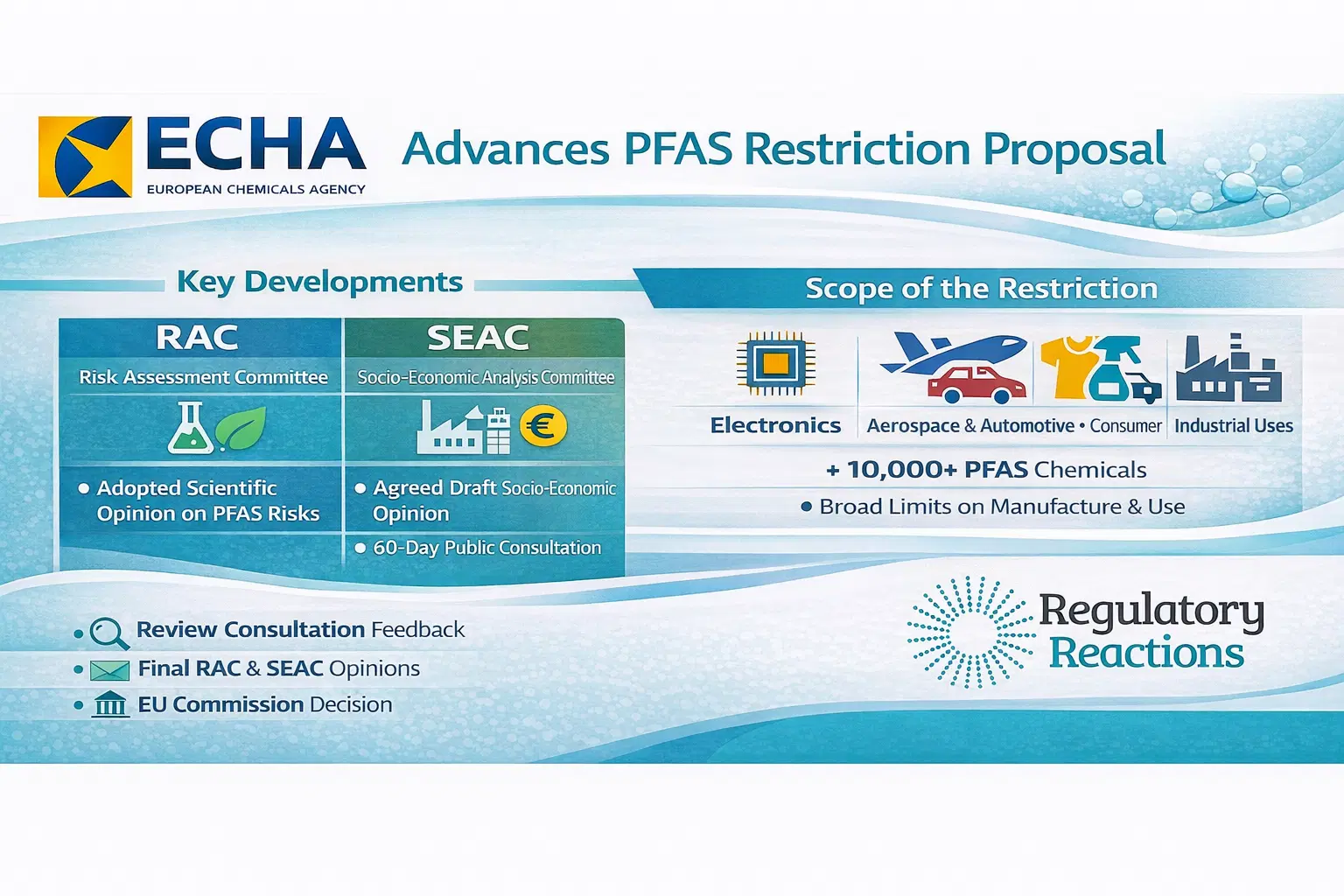
Brussels, Belgium, March 2026 — The European Chemicals Agency (ECHA) has reached a major milestone in the EU’s effort to regulate per- and polyfluoroalkyl substances (PFAS) after both of its scientific committees advanced their opinions on the proposed EU-wide restriction under the REACH Regulation.
Last week, ECHA announced that its Risk Assessment Committee (RAC) has adopted its scientific opinion on the PFAS restriction proposal, while the Socio-Economic Analysis Committee (SEAC) has agreed on its draft opinion, triggering the next stage of the regulatory process.
Together, these steps move the proposal closer to a final decision by the European Commission and EU Member States.
RAC Adopts Scientific Opinion on PFAS Risks
ECHA’s Risk Assessment Committee (RAC) evaluated whether the proposed restriction is appropriate to reduce risks to human health and the environment associated with PFAS use.
RAC’s assessment focuses on evaluating the risk to the environment and human health and whether exposure during the production, use and waste generation of products warrant a restriction.
The PFAS restriction proposal — submitted in January 2023 by authorities from Denmark, Germany, the Netherlands, Norway, and Sweden — targets a broad group of fluorinated chemicals commonly known as “forever chemicals.” These substances are widely used in industrial and consumer applications due to their water-repellent, grease-resistant, and heat-resistant properties.
However, PFAS are also extremely persistent in the environment and can accumulate over time, raising concerns about long-term exposure and contamination.
RAC’s adopted opinion represents the scientific risk evaluation phase of the REACH restriction process.
SEAC Agrees Draft Opinion on Socio-Economic Impacts
In parallel with RAC, ECHA’s Socio-Economic Analysis Committee (SEAC) has agreed its draft opinion on the PFAS restriction proposal.
While RAC focuses on risk, SEAC evaluates the broader economic and societal implications of the restriction, including:
costs of compliance for industry
availability and feasibility of alternatives
potential impacts on innovation and supply chains
broader societal benefits from reducing PFAS emissions.
The SEAC draft opinion will now be subject to a 60-day public consultation, during which stakeholders can submit additional information on socio-economic impacts and alternatives to PFAS.
This consultation is expected to be the last major opportunity for industry and other stakeholders to influence the final evaluation of the restriction proposal.
Restrictions Covering Thousands of Chemicals
The proposed restrictions are considered some of the most far-reaching chemical restrictions ever proposed under REACH.
It would limit the manufacture, placing on the market, and use of PFAS in substances, mixtures, and articles across numerous industries.
The proposal uses a group approach that could affect more than 10,000 PFAS substances, reflecting regulators’ concerns about their persistence and widespread environmental contamination.
PFAS are used in a wide range of applications, including the following:
electronics and semiconductors
aerospace and automotive components
textiles and consumer goods
construction materials and coatings
industrial processing equipment.
Since PFAS are embedded across global supply chains, the restriction could have significant implications for manufacturers, importers, and suppliers of products on the EU market.
What Happens Next
Following SEAC’s consultation and further review, both committees are expected to finalize their opinions in 2026.
The next steps in the REACH restriction process include:
Final RAC and SEAC opinions submitted to the European Commission
The Commission preparing a legislative restriction proposal
EU Member States voting through the REACH Committee
If adopted, the restriction could impose broad limits on PFAS across the EU, with transition periods and sector-specific derogations potentially extending for several years.
Implications for Industry
For companies operating in the EU market, the advancement of both RAC and SEAC opinions signals that the PFAS restriction is entering its final regulatory stages.
Businesses should monitor:
sector-specific exemptions and transition periods
availability of PFAS alternatives
upcoming consultation opportunities to provide technical and economic data.
Product brand owners should also audit their supply chains, obtain declarations from suppliers, or implementing testing plans to ensure that products do not contain PFAS. Some brands may be subject to re-formulation
Given the scale of PFAS use across industrial and consumer applications, the final decision could reshape material selection, product design, and supply chain strategies for companies worldwide.