
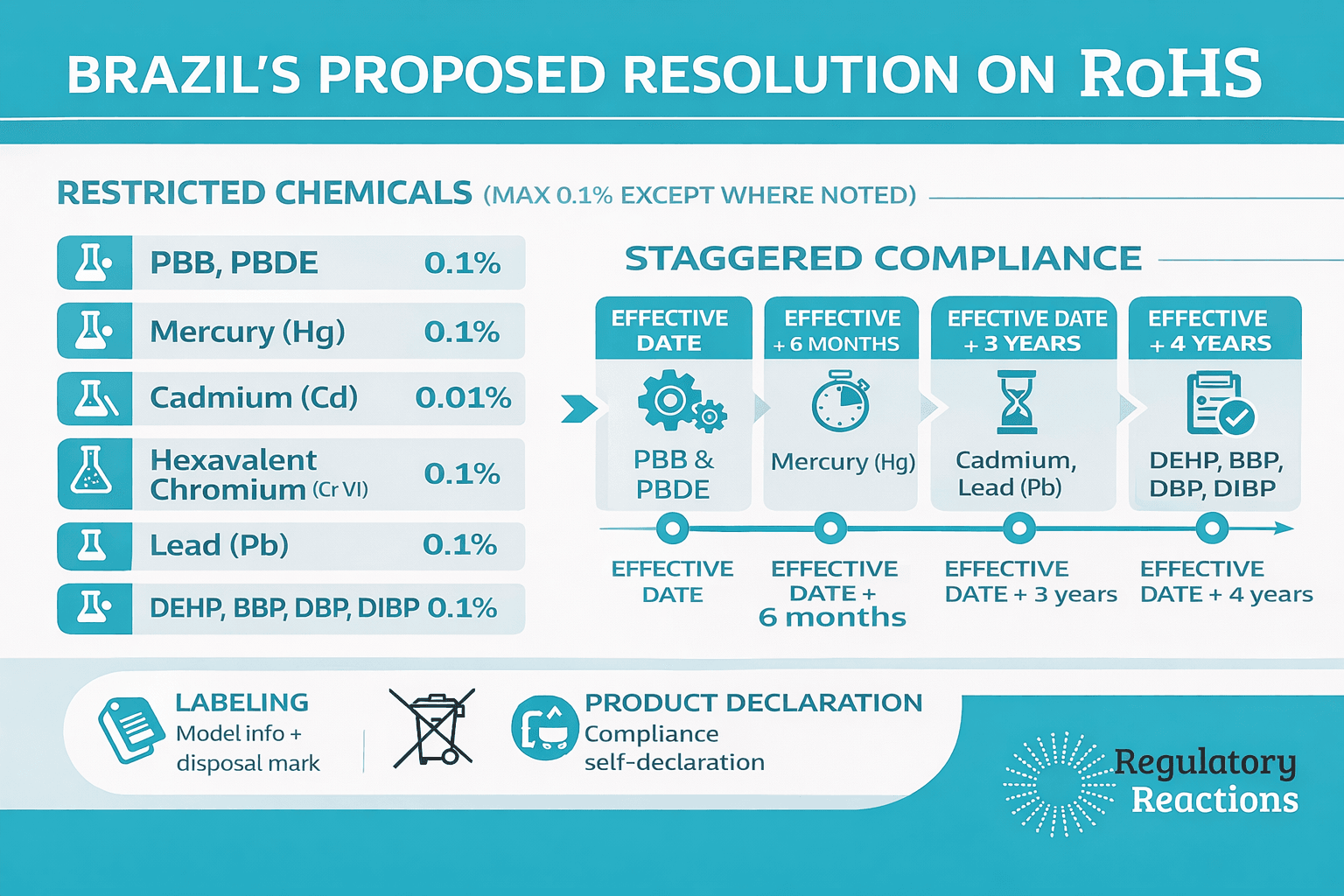
Brasília, Brazil, March 2026 — Brazil’s National Council for the Environment (CONAMA) has released a revised draft of its RoHS-style regulation restricting hazardous substances in electrical and electronic equipment (EEE), refining the 2025 proposal with clearer definitions, an exemptions framework, and detailed compliance mechanisms.
The updated draft largely maintains alignment with the EU RoHS framework but introduces important clarifications on responsible parties and implementation procedures, while reinforcing a national registration and self-declaration system as a condition for market access.
Expanded definitions of responsible parties
The March 2026 revision broadens the definition of “manufacturer” to include any entity that produces, transforms, assembles, or commissions EEE, including those placing products on the market under their own brand. Importers are defined as entities responsible for introducing EEE into Brazil for distribution or commercialization. This distinction potentially exempts companies who imports parts for their own use.
Exemptions Framework to Be Established
The proposal requires the Ministry of Environment and Climate Change to publish, within 180 days of the regulation’s entry into force, an initial list of exemptions and applicable uses. It must also define procedures for requesting, evaluating, renewing, or revoking exemptions. Manufacturers and importers may subsequently apply for exemptions under these criteria.
Restricted substances and limits
The draft maintains the same substance restrictions and concentration limits (in homogeneous materials) as the 2025 proposal:
PBB, PBDE: 0.1%
Mercury (Hg): 0.1%
Cadmium (Cd): 0.01%
Hexavalent chromium (Cr VI): 0.1%
Lead (Pb): 0.1%
Phthalates (DEHP, BBP, DBP, DIBP): 0.1%
The requirements apply broadly to EEE, including cables and spare parts, across categories such as household appliances, IT and telecom equipment, consumer electronics, lighting, photovoltaic products, monitoring devices, medical and veterinary equipment, and toys.
Excluded from scope are military and space equipment, large-scale industrial systems, most transport equipment, off-road professional machinery, implantable medical devices, batteries, and R&D-only equipment.
Staggered deadlines for chemical restrictions
The draft preserves phased compliance timelines:
PBB and PBDE: effective upon entry into force
Mercury: within 180 days
Cadmium, lead, and hexavalent chromium: within 3 years
Phthalates: within 4 years
Registration & Declaration
A central feature of the proposal is a mandatory national registration and self-declaration system. Before placing EEE on the market, manufacturers and importers must register each product, model, or product family in a national database and issue an autodeclaração de conformidade.
This declaration must confirm compliance with substance restrictions or applicable exemptions and include:
Identification of the manufacturer or importer
Product traceability information
Material-level compliance confirmation
Applicable exemptions
Both the company and its legal representative bear administrative and criminal liability for the accuracy of the declaration.
The self-declaration is a market access requirement. It must accompany the product physically or via digital access and be publicly available online. If not immediately accessible, it must be provided within five working days upon request.
Labelling
EEE must include traceability information in Portuguese, such as model identification, serial or batch number, and manufacturer or importer details. Where physical labeling is impractical, information may be provided through packaging or digital tools.
Products subject to reverse logistics must display a selective disposal symbol (e.g., crossed-out trash bin). General labeling obligations take effect with the conformity declaration, while disposal marking becomes mandatory within two years of the regulation’s entry into force.
Enforcement
Authorities may request samples, conduct laboratory testing, and review technical documentation. In cases of non-compliance, companies must notify authorities, halt distribution, implement corrective measures, and recall products where necessary. Public communication of risks and corrective actions is also required.
The March 2026 revision removes a provision requiring companies to bear the full cost of consumer notification in cases where products have already been sold, but the obligation to inform the public remains.
Global perspective
The framework aligns Brazil with established RoHS regimes in the EU, China, Japan, and other jurisdictions. While Brazil does not introduce a conformity marking system, the mandatory self-declaration closely resembles EU CE marking processes in practice.
Implication for business
The regulation will introduce additional compliance and administrative costs, particularly related to registration and documentation. However, companies already compliant with EU RoHS requirements will benefit from significant regulatory alignment, reducing duplication and easing market entry into Brazil.