
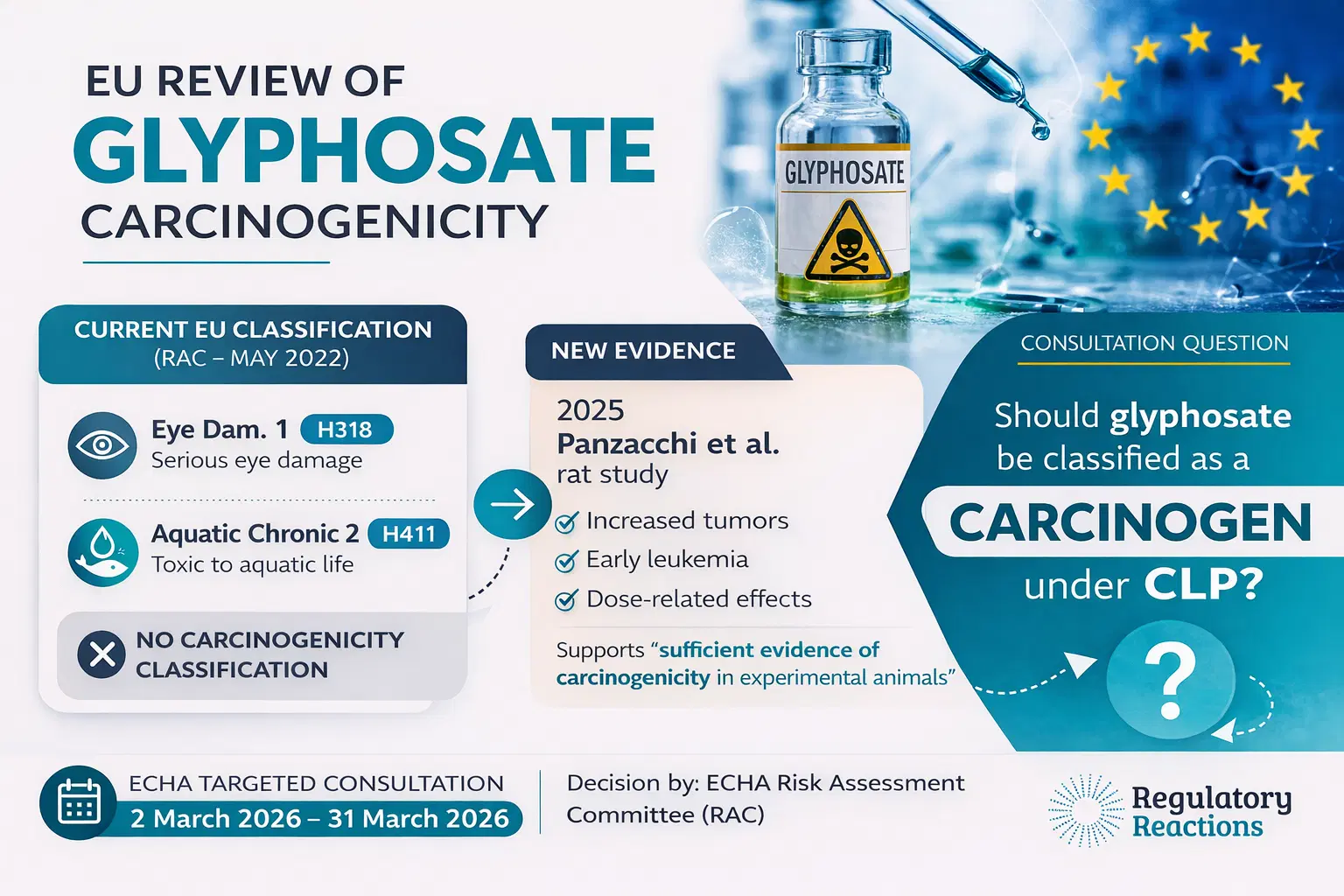
Brussels, EU,March 2026 — The European Union has reopened a scientific review of Glyphosate after a newly published animal study prompted regulators to reassess whether the herbicide’s hazard classification should change under EU chemical law.
The review follows a request from the European Commission asking the European Chemicals Agency (ECHA) to evaluate new carcinogenicity data published in June 2025 in the journal Environmental Health. The study—by Panzacchi and colleagues—reported increased incidences of multiple tumors in laboratory rats exposed to glyphosate and glyphosate-based herbicides.
ECHA has now launched a targeted public consultation, ending on 31 March 2026, so that stakeholders can comment on the scientific relevance and reliability of the study before the agency’s Risk Assessment Committee (RAC) determines whether the findings affect the EU’s existing hazard classification for glyphosate.
RAC’s 2022 conclusion remains the starting point
The consultation centers on whether the new study could change the conclusions reached in May 2022, when RAC adopted its opinion on the harmonised classification of glyphosate.
At that time, RAC concluded the substance should retain its existing classifications under the EU’s Classification, Labelling and Packaging Regulation:
Eye Dam. 1; H318—Causes serious eye damage
Aquatic Chronic 2; H411 - Toxic to aquatic life with long-lasting effects
At that time, RAC also determined that glyphosate did not meet the criteria for classification as a carcinogen under the CLP Regulation.
The new consultation is limited to the newly published study and whether such study could alter RAC’s earlier conclusion on carcinogenicity and does not reopen glyphosate’s entire classification.
The study at the center of the review
The paper prompting the review—Panzacchi et al., 2025—examined long-term exposure to glyphosate and glyphosate-based herbicides in Sprague–Dawley rats.
The research exposed animals to the herbicide from prenatal life through 104 weeks, using dose levels corresponding to the EU acceptable daily intake (ADI), ten times the ADI, and the EU no-observed-adverse-effect level (NOAEL).
According to the authors, the experiment found increased incidences of multiple benign and malignant tumors, including leukemia and tumors affecting organs such as the liver, thyroid, mammary glands, adrenal glands, kidneys, bladder, bone, uterus, and spleen. The study also reported early onset and mortality associated with leukemia in exposed animals.
The study concludes that glyphosate and glyphosate-based herbicides produced tumor increases even at exposure levels corresponding to the EU ADI and NOAEL and that the findings support the conclusion that there is sufficient evidence of carcinogenicity in experimental animals. The authors also suggested that co-formulants in herbicide formulations may enhance carcinogenic effects, particularly in relation to leukemia.
Why ECHA is consulting now
Since the study was published after RAC issued its 2022 opinion, the European Commission asked ECHA—under Article 77 of the REACH Regulation—to have RAC examine the new data.
The targeted consultation allows interested parties to submit scientific comments on:
the relevance of the study
the quality and methodology of the research
the interpretation of the results in relation to CLP classification criteria
Importantly, ECHA says the review is limited to the Panzacchi study itself, though the findings must be evaluated alongside the broader carcinogenicity evidence RAC assessed in 2022.
A high-stakes scientific question
Glyphosate has long been one of the most scrutinized chemicals in global regulatory policy. Diverging assessments—particularly following the 2015 carcinogenicity classification by the International Agency for Research on Cancer—have fueled intense debate over the herbicide’s safety.
The new consultation illustrates how emerging scientific evidence can reopen hazard discussions even after regulatory conclusions have been reached. However, the consultation itself does not imply that glyphosate will be reclassified. RAC must first determine whether the new findings are robust and relevant enough to change its previous assessment. A new classification, however, may trigger new regulatory measures and reopen the debate about this chemical and its usage.