
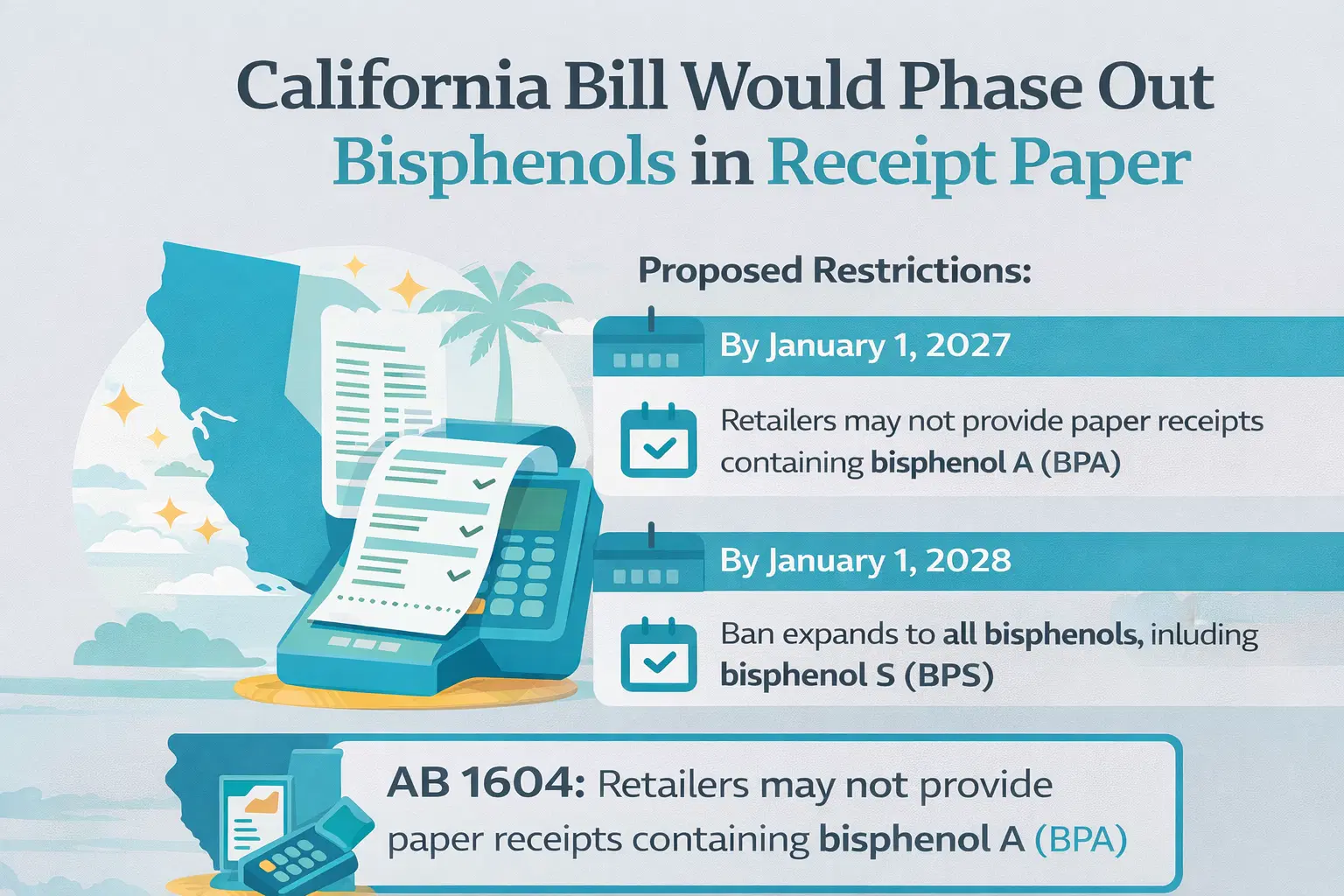
Sacramento, CA, United States, March 2026 — California lawmakers are advancing legislation that would eliminate bisphenols from thermal paper receipts. Assembly Bill 1604 (AB 1604) would prohibit retailers from providing paper proofs of purchase containing intentionally added bisphenols, starting with bisphenol A (BPA) in 2027 and expanding to all bisphenols in 2028.
If enacted, the measure would place new compliance obligations on retailers, receipt paper manufacturers, and point-of-sale supply chains, while aligning California with a growing regulatory trend targeting endocrine-disrupting chemicals in consumer products.
Part of a Broader Chemical Control Trend
California has been at the forefront of chemical restrictions in consumer products, particularly through laws targeting PFAS, phthalates, and other endocrine-disrupting chemicals. AB 1604 follows a growing global effort to reduce bisphenol exposure.
Earlier regulatory actions often targeted individual chemicals, such as BPA. Connecticut has previously banned BPA in thermal paper, while the European Union restricted BPA (concentrations ≤ 0.02% by weight) in thermal paper under REACH. New York does not have a statewide BPA receipt ban, but Suffolk County adopted the Safer Sales Slip Act, which prohibits businesses from issuing thermal receipts containing BPA.
However, regulators increasingly recognize that such approaches can lead to regrettable substitution, where manufacturers replace one restricted chemical with structurally similar alternatives. California’s bill expands the ban to the entire class of bisphenols, which is similar to a ban that takes effect in January 2026 in Washington State. Washington’s restriction and California’s proposed approach under AB 1604 reflect a broader trend toward class-based chemical regulation. The shift also reflects increasing concern about bisphenols’ potential links to hormonal disruption, reproductive effects, and certain cancers.
Proposed Compliance Timeline
AB 1604 authorizes civil penalties for violations of the proposed receipt restrictions. Businesses that manufacture, sell, distribute, or provide non-compliant thermal receipt paper could face penalties of up to 5 000 USD for a first violation and up to 10 000 USD for each subsequent violation. Enforcement authority would rest with the California Department of Toxic Substances Control (DTSC), the California Attorney General, and local prosecutors, with collected penalties deposited into the state’s Toxic Substances Control Account.
AB 1604 — Proposed Compliance Timeline
Retailers may not provide paper proofs of purchase containing intentionally added bisphenol A (BPA).
Prohibition expands to all intentionally added bisphenols, including substitutes such as bisphenol S (BPS).
Impacted Industries
The California proposal would affect several sectors involved in retail transactions and receipt production. Retailers would need to ensure that receipts provided to consumers are free of bisphenols, while manufacturers of thermal paper may need to reformulate receipt coatings to eliminate these chemicals. Point-of-sale (POS) technology providers could see increased demand for digital receipt systems as businesses seek alternatives to paper receipts. Procurement and supply chain teams may also need to verify that receipt paper supplied to retailers complies with the new requirements. As a result, many companies may transition to phenol-free thermal paper alternatives or digital receipt solutions to meet the proposed restrictions.
What should businesses do?
Although the bill is still moving through the legislative process, companies may want to begin evaluating their exposure risks.
Key steps include:
Auditing receipt paper suppliers
Confirming whether thermal paper contains BPA, BPS, or other bisphenols
Considering digital receipt systems
Monitoring legislative progress and potential amendments
For companies operating nationally, the bill could signal another regulatory trend likely to expand beyond California.