



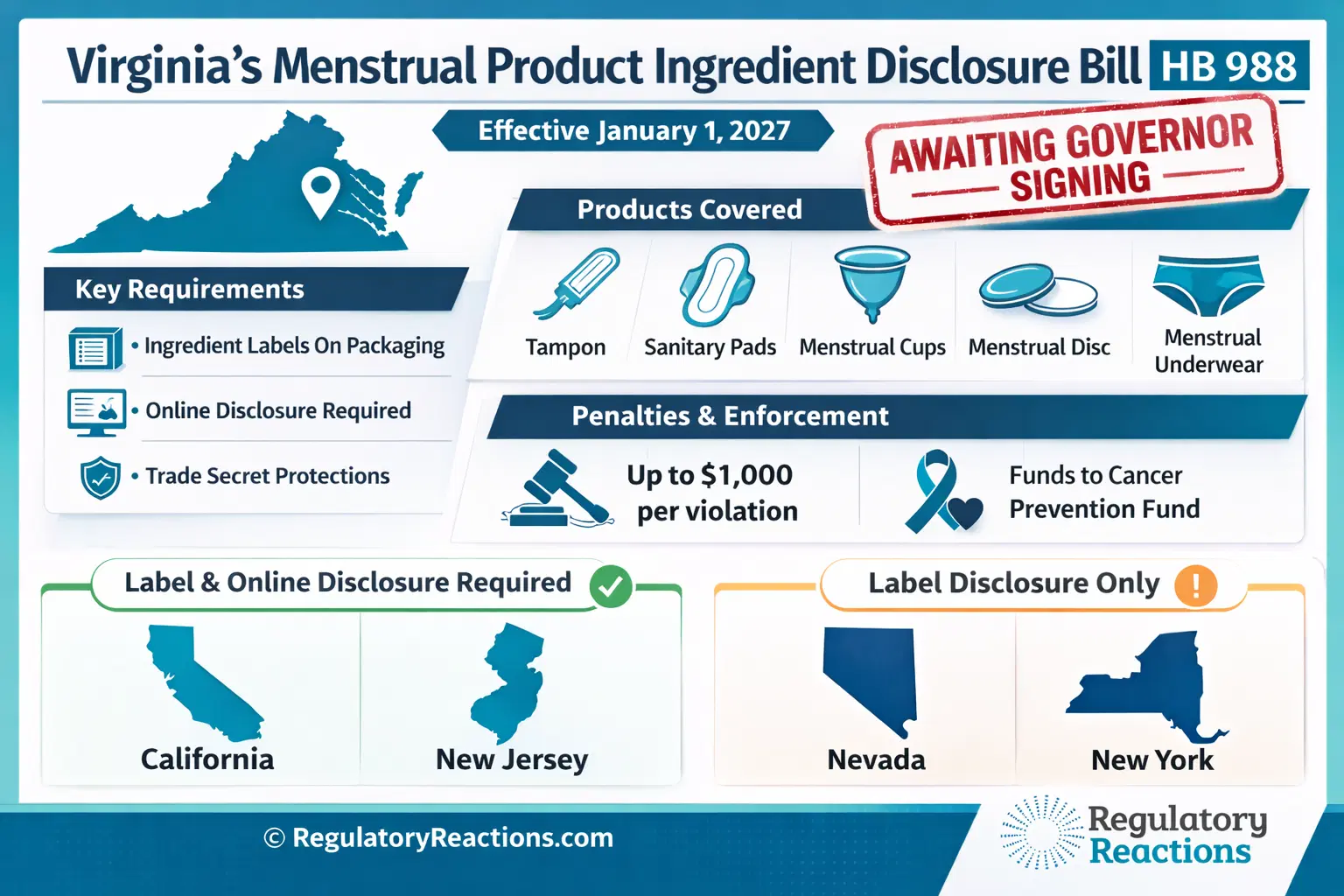
Richmond, VA, US, March 2026 — Virginia is poised to join a growing number of U.S. states requiring greater transparency in menstrual health products after lawmakers approved legislation mandating ingredient disclosure for menstrual supplies sold in the Commonwealth.
The measure, House Bill 998 (HB998), would require manufacturers of products such as tampons, sanitary pads, menstrual cups, discs, and menstrual underwear to disclose product ingredients on packaging and online. Supporters say the bill aims to give consumers clearer information about substances used in products that come into close contact with the body.
If enacted, the legislation would take effect January 1, 2027, placing new compliance obligations on manufacturers distributing menstrual products within the Commonwealth.
Mandatory Ingredient Disclosure
The legislation would require every package or box of menstrual supplies sold in Virginia to include a label listing all intentionally added ingredients used in the product.
Ingredients must be:
Listed in descending order of predominance
Presented in a clear and visible format
Displayed on the consumer-facing packaging
The bill defines menstrual supplies broadly as products used to capture menstruation or vaginal discharge, including:
Tampons
Sanitary pads
Menstrual cups
Menstrual discs
Menstrual underwear
Manufacturers that modify a product’s formulation must update labels within 18 months after the modification.
Online Ingredient Transparency
In addition to labeling requirements, HB998 would require manufacturers to make ingredient information available electronically, typically through a company website.
Manufacturers must ensure that:
The same ingredient list appearing on the package is accessible online
Ingredient information is updated when formulations change
These digital disclosure requirements are intended to ensure that consumers can easily access ingredient information even after the product packaging is discarded. Manufacturers may use technologies, including a digital link or QR codes, to direct consumers to the website.
Trade Secret Protections
The bill includes provisions designed to protect confidential business information. Manufacturers may withhold the precise identity of substances that qualify as protected trade secrets, including chemicals listed as confidential under the U.S. Toxic Substances Control Act (TSCA) or protected under federal trade secret law or are generally recognized as safe (GRAS) by the U.S. Food and Drug Administration.
However, when a substance is protected, companies must still disclose the common name of the ingredient.
Enforcement and Penalties
The legislation authorizes civil penalties for companies that fail to comply with the disclosure requirements.
Violations could result in civil penalties of up to $1,000 per violation, with collected funds directed to Virginia’s Breast and Cervical Cancer Prevention and Treatment Fund.
Growing National Trend Towards Regulating Menstrual Products
Virginia’s proposal reflects a broader trend across the United States in which states are increasingly regulating menstrual products and personal care through ingredient transparency laws and chemical safety frameworks.
Several states have adopted laws requiring manufacturers to disclose ingredients used in menstrual products. If the legislation is enacted, Virginia would join California and New Jersey in requiring ingredient disclosure on the labels and online websites. Nevada and New Jersey require ingredient disclosure on the labels.
In addition to ingredient transparency, states have also focused on regulating menstrual products through restricting certain substances in menstrual products
Compliance Implications for Industry
If enacted, HB998 could require manufacturers distributing menstrual products in Virginia to implement new compliance measures, including the following:
Ingredient inventory and verification
Packaging updates to include full ingredient lists
Website disclosure systems for product formulations
Supply chain documentation for proprietary substances
For companies selling products nationwide, the Virginia legislation may further accelerate the need for harmonized ingredient disclosure strategies across multiple state markets. While many of these requirements will impact manufacturers and importers, suppliers and retailers of menstrual products should also ensure products are compliant with these requirements.
| State | Ingredient Labeling Requirement | Chemical Restrictions | Compliance Timeline | Primary Statute |
|---|---|---|---|---|
| Virginia | Ingredient labeling on packaging + electronic disclosure | N/A | 1 January 2027 – ingredient labeling | HB 998 |
| California | Ingredient labeling on packaging + online disclosure | PFAS (intentionally added PFAS prohibited; PFAS exceeding total organic fluorine threshold prohibited) | 1 January 2023 – ingredient labeling 1 January 2025 – chemical restriction (PFAS – intentionally added) 1 January 2027 – chemical restriction (PFAS – total organic fluorine threshold) |
HSC §111822.2 |
| New York | Ingredient labeling on packaging | PFAS; lead; mercury; formaldehyde; triclosan; toluene; talc; dibutyl phthalate (DBP); diethylhexyl phthalate (DEHP); butylphenyl methylpropional; isobutylparaben; isopropylparaben; butylparaben; propylparaben | 1 March 2020 – ingredient labeling 19 December 2026 – chemical restrictions |
GBL §399-AAAA |
| Nevada | Ingredient labeling on packaging | N/A | 1 January 2025 – ingredient labeling | NRS §585.519 |
| New Jersey | Ingredient labeling on packaging + website disclosure | N/A | 12 January 2026 – act effective 12 July 2027 – ingredient labeling |
S 3643 |
| Colorado | N/A | PFAS (intentionally added PFAS prohibited) | 1 January 2025 – chemical restriction (PFAS) | C.R.S. §25-15-604 |
| Minnesota | N/A | PFAS (intentionally added PFAS prohibited in menstrual products) | 1 January 2025 – chemical restriction (PFAS) 1 January 2026 – PFAS reporting 1 January 2032 – chemical restriction (PFAS – product ban unless unavoidable use) |
Minn. Stat. §116.943 |
| Maine | N/A | PFAS (intentionally added PFAS subject to reporting and future ban) | Reporting requirement currently suspended pending rulemaking 1 January 2030 – chemical restriction (PFAS – product ban unless unavoidable use) |
38 M.R.S. §1614 |
| Connecticut | N/A | PFAS (intentionally added PFAS prohibited in menstrual products) | 1 January 2028 – chemical restriction (PFAS) | C.G.S. §22a-903c |
| New Hampshire | N/A | PFAS (intentionally added PFAS prohibited in feminine hygiene products) | 1 January 2027 – chemical restriction (PFAS) | RSA 149-M:64 |
| Rhode Island | N/A | PFAS (intentionally added PFAS prohibited in menstrual products) | 1 January 2027 – chemical restriction (PFAS) | R.I. Gen. Laws §23-18.18-3 |
| Vermont | N/A | PFAS; ortho phthalates; formaldehyde; methylene glycol; mercury compounds; triclosan; 1,4 dioxane (threshold based); lead compounds; asbestos; m phenylenediamine and salts | 1 January 2026 – chemical restriction (PFAS; ortho phthalates; formaldehyde; methylene glycol; mercury compounds; triclosan) 1 January 2026 – chemical restriction (1,4 dioxane ≥10 ppm) 1 January 2027 – chemical restriction (1,4 dioxane ≥2 ppm) |
9 V.S.A. §2494b |