
By Nidia Mariana Calvo*
Lima, Peru, 30 June 2026 - Peru is moving into a new era of chemical compliance. Under Supreme Decree No. 005-2026-MINAM, companies that manufacture, import, distribute, commercialize, transport, or use chemical substances in Peru must prepare for a national system centered on the sixth revised edition of the United Nations’s Globally Harmonized System of Classification and Labelling of Chemicals, or GHS.
The country’s adoption of GHS means classification, labeling, and safety data sheets under GHS are mandatory for the commercialization and use of chemical substances in Peru.
Companies must classify their chemicals
Manufacturers are responsible for classifying the hazards of chemical substances. Importers must coordinate with the foreign manufacturer or other relevant party to ensure the classification is correct.
Peru will also use an official reference list, the Listado de Clasificación Anticipada de Peligros de Sustancias Químicas, or LCA. However, the LCA is only a minimum reference. Companies still remain responsible for the full GHS classification and must add any additional hazard classes or categories that apply.
In practical terms, companies must self-classify. They cannot rely only on the government list if the substance has other hazards.
Manufacturers and importers must keep the technical evidence supporting the classification for at least 10 years, either physically or digitally, and make it available to authorities.
Labels must be in Spanish
Labels for chemical substances manufactured in Peru or imported into Peru must be in Spanish. Other languages may be added, but Spanish is mandatory. For hazardous substances, labels must include the following elements:
| Required Label Element | Requirement |
|---|---|
| Manufacturer/importer identification | Name, address and telephone number |
| Hazard statements | Standard GHS hazard phrases |
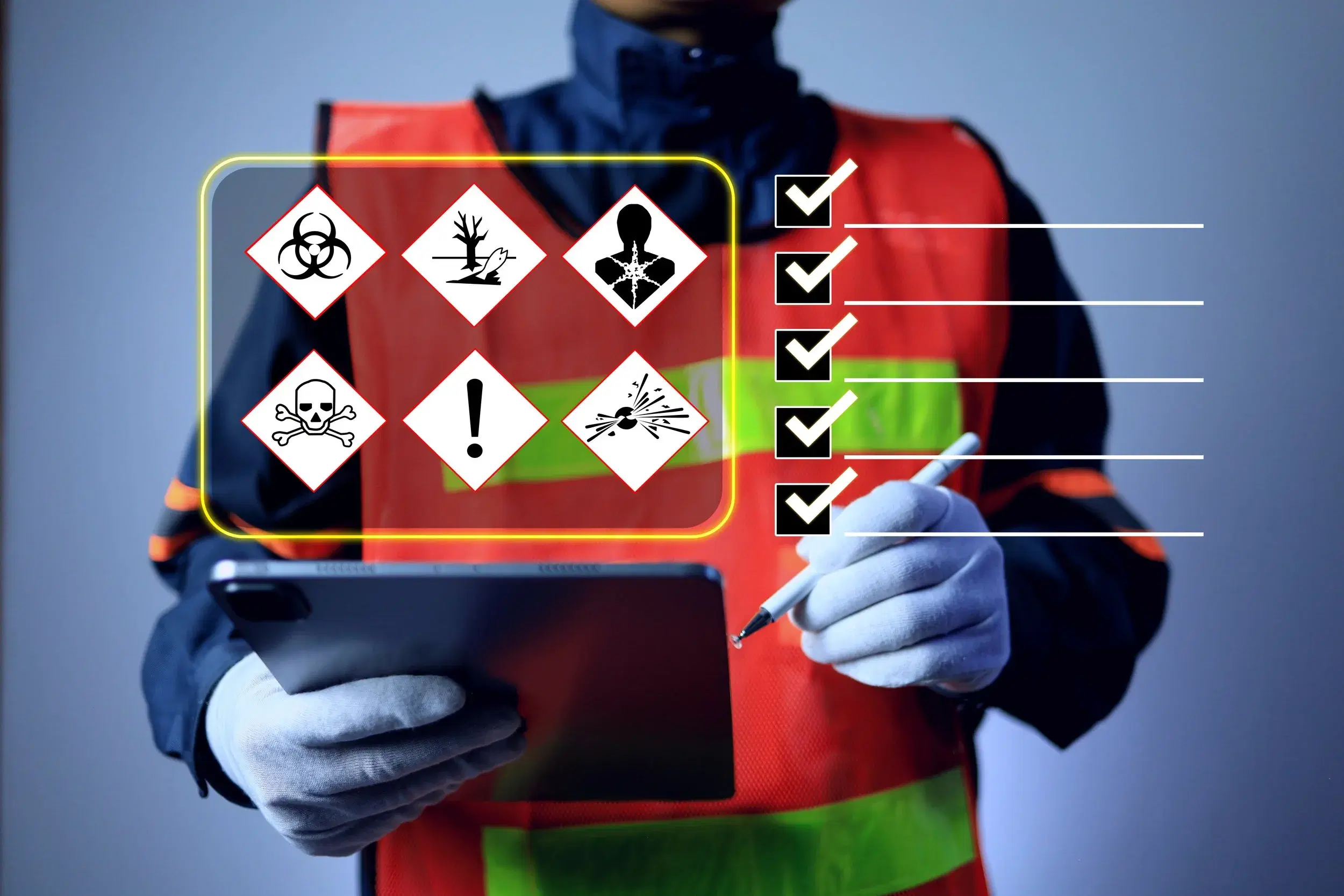
| Pictograms | GHS hazard pictograms |
| Precautionary statements | Measures to prevent or minimize harm |
| Signal word | “Peligro” or “Atención” |
| Product identifier | Product name and CAS number, where applicable |
| Supplementary information | Allowed if it does not conflict with GHS or the regulation |
For non-hazardous substances, the label must at least identify the product and the manufacturer or importer.
Label and pictogram sizing rules
The regulation sets minimum label and pictogram sizes based on container capacity.
| Container Capacity | Minimum Label Size | Minimum Pictogram Size |
|---|---|---|
| 250 ml to 3 L | 52 × 74 mm, if possible | 10 × 10 mm; ideally 16 × 16 mm |
| More than 3 L to 50 L | 74 × 105 mm | 23 × 23 mm |
| More than 50 L to 500 L | 105 × 148 mm | 32 × 32 mm |
| More than 500 L | 148 × 210 mm | 46 × 46 mm |
Each hazard pictogram must cover at least one-fifteenth of the minimum label surface, and the pictogram surface cannot be smaller than 1 cm².
The regulation does not set a fixed maximum number of pictograms. The pictograms must match the substance’s GHS classification. However, the regulation does limit precautionary statements. Labels for hazardous substances must include at least one prevention-related precautionary statement and should not include more than six precautionary statements unless more are needed to reflect the nature and severity of the hazards.
Small containers get reduced labelling, not a full exemption
Small containers below 250 ml may use reduced label elements where full labelling is not possible.
| Container Size | Minimum Required Information |
|---|---|
| 125 ml to 250 ml, with more than two hazard classes | Product identifier, pictograms, signal word, hazard statements and instruction to read the full outer or attached label |
| 10 ml to less than 125 ml | Product identifier, pictograms, signal word, health hazard statements and instruction to read the full outer or attached label |
| More than 5 ml to less than 10 ml | Product identifier, pictograms and instruction to read the full outer or attached label |
| 5 ml or less | Product identifier and instruction to read the full outer or attached label |
Labels must appear on all mobile containers. For temporary high-rotation containers, such as sampling containers, the label may include only pictograms and the signal word, but the full label must be available on the main container or at the point of use.
For stationary tanks, the label must include at least the pictograms and signal word. The complete label must be available at the entrance to the containment area. Labelling for quality-control samples is optional.
Hazardous labels cannot downplay the danger
If a substance is classified as hazardous, the label cannot include statements such as “non-toxic,” “not harmful,” “non-polluting,” “ecological,” or similar claims that contradict the classification.
Safety Data Sheets must follow GHS format
Manufacturers must prepare and supply safety data sheets (SDS), otherwise known as “FDS” in the regulation. Importers must coordinate with the foreign manufacturer or relevant party to ensure the SDS is compliant.
The FDS must be in Spanish and follow the 16-section GHS format, covering identification, hazards, composition, first aid, firefighting, accidental release, handling and storage, exposure controls, physical and chemical properties, stability, toxicology, ecotoxicology, disposal, transport, regulatory information, and other information.
The first page must show:
the GHS edition used;
the issue date; and
the version number.
The SDS must be available at points of use and easily accessible in physical or electronic form. Manufacturers and importers must provide it free of charge, preferably digitally.
When must labels and SDS be updated?
Companies must update classification, labels, and SDS when new information affects the hazard classification or the risk-management measures in the SDS, including but not limited to when a new national chemical restriction or regulation affects the classification rules or risk-management information. The update must be completed within one year from the triggering event, or before the company exhausts its stock of labels and SDS, whichever happens first.
Separately, SDS must be reviewed and updated at least every five years. The revised version must be sent to MINAM or MINSA, depending on the competent authority.
Implications for industries
From a Latin American perspective, Peru is following the steps of Argentina, Brazil, Colombia, and Chile in adopting GHS. However, Peru’s adoption of the sixth revision aligns more closely with Colombia than the other LatAm countries. For some products, this harmonization will allow products with similar labels to be sold in different countries with minor changes. Nevertheless, labels & safety data sheets for some products must be reviewed in light of the differences between the sixth and seventh revisions that Brazil and Chile have implemented before the products could be sold in all three countries.
For domestic companies or those who have not complied with GHS requirements in other countries, these new requirements might pose initial challenges such as classifying the various products and preparing compliant labels & safety data sheets. The government’s pre-classification list may help, but it does not replace the company’s obligation to classify the substance correctly. Companies that already complied with GHS in Brazil, Chile, or Colombia might find the labeling process much easier to navigate.

Nidia Mariana Calvo is a senior regulatory affairs & compliance leader based in Guadalajara, Mexico, with 20+ years’ experience supporting cosmetics, electronics, chemicals, and consumer products across the Americas. She specializes in LATAM regulatory strategy, regulatory intelligence platform design and content, and global chemical frameworks including REACH, TSCA, CLP/GHS, RoHS, and EPR—managing programs that span 15+ countries and leading cross-functional teams. Holding dual M.Sc. degrees in Environmental Planning and Corporate Sustainability and with leadership roles at ENHESA, HP and IBM, she helps organizations secure market access, mitigate regulatory risk, and align compliance with business objectives.